Showing posts with label Vojvodina. Show all posts

May 24, 2013

Architecture of Bus Stations in Serbia

Central Bus Station in Niš (picture from wikimapia)

I got inspired for this post by Yomadic's blog entry: http://www.yomadic.com/bus-from-belgrade-to-nis-serbia/ and his beautiful picture of the Niš Bus station.

Since in the Balkans, particularly in Serbia, Railway travelling was never so popular like traveling by bus, some Bus Stations got a lot of architectural attention when they were built.

I found pictures from some interesting Bus Stations and hope to expand this collection soon!


Niš Bus Station

Entrance of the Bus Station (picture wikimapia)
One of them is the Bus Station in Nis (Ниш) built in 1977 and one of the most modern Bus Station of the Socialist Federal Republic of Yugoslavia with 18 platforms. Nis-Ekspress AD was the main investor.

Ćuprija Bus Station

Bus Station in Čuprija


A lot of inhabitants of Ćuprija work as "Gastarbeiter" in Western Europe, so really lots of Bus Lines serve this little town. That explains the big Bus Station at the entrance of the town.
A close up shows the lamellar structure of the roof supported by precast columns arranged in a semi-circle.


Novi Pazar
A postcard from the 70's of Novi Pazar's Bus Station
Another interesting Bus Station  is the one in Novi Pazar built in the 1970's. The first time I visted Novi Pazar I was fascinated by it's frivolous architecture (read it in my post about Novi Pazar).

A newer picture on autobusi.net
The Bus Station fits in that style, and though it shows signs of age and people complain about its flaws it still looks charming.

Loving this combination: the bus station and his "soliter" a stand alone highrise building (from autobusi.net)


Zrenjanin

Zrenjanin Bus Station (from autobusi.net)

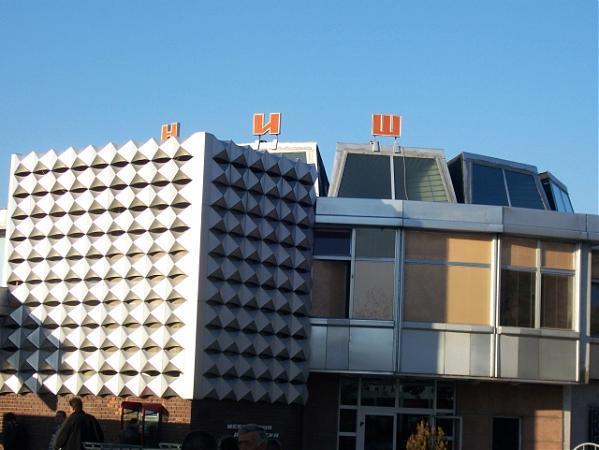
In Zrenjanin the Bus Station has a relief-like Fassade like in Niš. It/s not a big station, but with this detail it looks almost like an airport.

June 27, 2012

Monastery Guide to Fruska Gora


 All the past posts about the Fruska Gora Monasteries and about the beautiful baroque town of Sremski Karlovci have been put in a practical printable travel guide you can download here on Issuu.

Here the links to the previous posts:
Fruska Gora Monasteries Overview 
Velika Remeta Monastery in Fruska Gora
Novo Hapovo Monastery in Fruska Gora
Krusedol Monastery in Fruska Gora 
Jazak Monastery in Fruska Gora
Beocin Monastery in Fruska Gora
Vrdnik-Ravanica Monastery in Fruska Gora
Grgetec Monastery in Fruska Gora
A few monasteries of Fruska Gora
Buildings in Sremski Karlovci


 http://issuu.com/francescamitrovic/docs/guide_fruska_gora_small


June 23, 2012

Buildings in Sremski Karlovci


The little city of Sremski Karlovci is a good starting ponit for the Fruska Gora National Park.
This historic town on the right bank of the Danube, is surrounded by vineyards and represents an example of integration of cultural and natural heritage.

It's a picturesque little Baroque Town with interesting buildings full of historical, academical and spiritual meaning.

he present day historic centre of Sremski Karlovci emerged from the development of the city during the 18th, 19th and at the beginning of 20th century.
The spontaneous development of an urban texture in the 18th century, when Karlovci was the largest Serbian town in the Danube area, was based on an earlier layout, as confirmed by historic sources and archaeological findings.


Since 1713, with the transfer of the Metropolitan seat in Karlovci, building activities were characterised by rapid development. With the growth of political importance and the role of Karlovci, the need arose for a public house to accommodate the new functions. The building activity was supported by the intelligent and ambitious metropolitans of Karlovci, as well as by rich traders and craftsmen, which together contributed to shaping the urban image of Karlovci around the middle of the 18th century. 

This image of the old town, which was to be finally completed in the last decade of the 19th century and in the begining of 20th century, is largely preserved until our times. The urban centre is organised around the Square of Branko Radiccevica and the surrounding streets, encompassing buildings which have an exceptional place in the cultural history of the Serbs, due to their architectural, artistic and functional values.

The Gymnasium of Karlovci (Карловачка гимназија) is the oldest secondary school in Serbia (picture).
The present building was built 1891st was designed by Julius Partos, Hungarian architect. When built, it was also the Patriarch's Palace and was considered the most representative building of the Serbian Vojvodina.

The interior of the Gymnasium is richly decorated (picture)


Clerical High School of Saint Arsenije, founded in 1794, is the first Serbian Clerical High School, founded three years after the Gymnasium of Karlovci by Mitropolitan Stefan Stratimirovic. The second half of the 19th century represent the golden age in the history of this school, when Ilarion Ruvarac became the rector, and Jovan Zivkovic was one of the professors. In that period one of the first departments for bee keeping was established in the school.


The Clerical school was closed in 1914, after the World War I reestablished in Belgrade. The modern Clerical school called "Saint Arsenije Sremac" was founded in 1964, in the Palace of the Common funds, built at the beginning of the 20th century by Patriarch Georgije Brankovic.


The Sremski Karlovci City Hall is located at the center of Sremski Karlovci, Serbia (picture). City hall was built in the period between 1808 and 1811 in neoclassicism style. It was constructed to be garrison of the nearby Petrovaradin fortress in Novi Sad, and later it become military building. Above the balcony is a coat of arms of Sremski Karlovci.

The most important event that occurred in this building is declaration of Serbian Vojvodina from a balcony by Josif Rajacic in May 1848, known in Serbia as May Assembly, during European Revolutions of 1848. In this building the temporary government of Serbian Vojvodina was organized and was called The Main National Council.
Now, in the City Hall is the administration, including town council and police.


The St. Nikola's Synod Church (Саборна Црква Цветог Николе) was begun in 1758, on the place of the old church of St. Nikola, from the Turkish times and upon the initiative of the metropolitan Pavle Nenadovic. In 1760 the tower and the dome were built, accordingto the project of Zahariie Orfelin, while the church was finally completed in 1762. It is single-naved building with a semi-circular apse on the east and two high baroque belfries on the west. A magnificent iconostasis, a masterpiece of Serbian baroque paining, a work of Teodor Kracun and Jakov Orfelin in 1781 with woodcarvings by Arsenije Markovic. Significant relics are kept in the church: a miracle icon of the Mother of Christ with the little Christ and one part of the relics of St. Arsenije I Sremac, the first Serbian archbishop after St. Sava. The two thrones are foreseen for the Serbian king and Serbian patriarch.


Links:
Fruska Gora Monasteries Overview 
Velika Remeta Monastery in Fruska Gora
Novo Hapovo Monastery in Fruska Gora
Krusedol Monastery in Fruska Gora 
Jazak Monastery in Fruska Gora
Beocin Monastery in Fruska Gora
Vrdnik-Ravanica Monastery in Fruska Gora
Grgetec Monastery in Fruska Gora


June 9, 2012

A few Monasteries of Fruska Gora Mountains


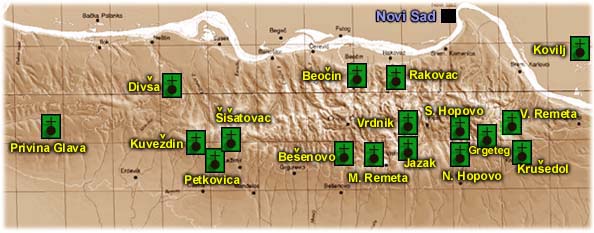
This post belongs to the series about the beautiful monasteries of the Fruska Gora (the only mount of the extended flat Vojvodina region in the National Park of Fruska Gora which is also a well know tourist destination).
This unique place lays between Novi Sad and Belgrade Airport and makes a good day trip (by car).

The links to the first 7 monasteries of the series (Velika Remeta, Novo Hapovo, Krusedol, Jazak, Beocin, Vrdnik-Ravanica and Grgeteg) are on the bottom of this post.

Here are a few others of the 15 preserved monasteries of the Fruska Gora National Park.

The Privina Glava Monastery (Манастир Привина Глава)

The monastery church is dedicated to the Council of the Holy Archangel Michael. According to the legends Privina Glava was founded by a man named Priva, in the 12th century. The monastery was named after him, so the tradition says. The legend also links the monastery to Jovan Brankovic (burried in Krusedol Monastery) and his brother, Bishop Maksim, who founded the monastery in 1496. The first documented evidence of Privina Glava is rendered by Turkish tax records of I566-67. The Monastery church is a single-dome structure with a trefoil base built between 1741 and 1760, after the model of the Novo Hopovo monastery church. The monastery residences were built on the South and partially on the East side of the church, between 1753 and 1771. The so-called zoograph icons on the old iconostasis were painted by Stanoje Popovic in 1747. The icons on the new iconostasis were painted by Andre Sartist in 1786. The murals in the central part of the church were made by Kuzman Kolaric between 1786 and 1791.


The Petkovica Monastery (Манастир Петковица)
The monastery church was dedicated to St. Petka. According to the tradition, founded by the widow of Stefan Stiljanovic (burried in Sisatovac Monastery), despotess Jelena. The monastery is first mentioned in Turkish documents of 1566-67. The church has a trefoil ground plan that has still been preserved, except for the wooden bell-tower, which was replaced in the mid-18th century. The fresco paintings, a good portion of which has been preserved, were finished in 1588. In the 18th century, the church was renovated several times, and in 1735 got a new iconostasis with a large carved cross. During World War II, the church was deserted and the icons carried off and lost forever. The iconostasis was destroyed and the cross moved to the Museum of Srem, in Sremska Mitrovica. The monastery has been partly renovated.


The Sisatovac Monastery (Манастир Шишатовац)
The monastery church is dedicated to the Birth of the Mother of God. The foundation of the monastery is ascribed to the refugee monks from the Serbian monastery of Zica who tore down the original church of St. Nicholas called Remetsko, and erected on its site a new church, which was dedicated to the Virgin, and named Sisatovac. The reliable facts illustrating the life of the monastery date from the mid-l6th century. In 1543, the relics of St. Stefan Stiljanovic were brought from Siklos to the monastery. The old two-domed church, which had been built by masters from Adriatic coast, Jovan and Gaspar, was destroyed in 1778. A new, larger one, donated by the bishop Vikentije Jovanovic-Popovic was built on its site. The monks' quarters were erected on three sides, while the fourth was closed by the church itself. The quarters acquired their present appearance at the beginning of the 19th century. The cemetery chapel was dedicated to St. Paul and St. Peter, and the chapel was built in 1750. The iconostasis and murals for the new church were made by Grigorije Davidovic-Obsic, in 1795. The monastery was destroyed during World War II. The reconstruction of the monastery is under way.


The Rakovac Monastery (Манастир Раковац)
The monastery church is dedicated to St. Cosmas and St. Damianos. According to a legend written in 1704, Rakovac is the heritage of a certain man, Raka, courtier of despot Jovan Brankovic. The legend states that Raka erected the monastery in 1498. The monastery got its name after him. The monastery was mentioned in the first Turkish census of Srem in 1546. The addition of a baroque bell-tower on to the West church facade, in 1735, entailed certain changes in the trefoil shape of the church and the whole monastery complex. The monks' quarters acquired their final appearance in 1771, surrounding the church on three sides. The church was supposed to be painted at the beginning of the 16th century. The only preserved parts of the frescos are those in the tambour of the dome. The icons on the baroque iconostasis were done by Vasilije Ostojic in 1763. The single-nave chapel in the monastery graveyard dedicated to the Shroud of the Mother of God, built in 1751, houses the iconostasis painted by Janko Halkozovic and Vasilije Ostojic, in 1755. The monastery was severely damaged in World War II and a lot of cultural, historical, and artistic valuables were irretrievably lost. The church has been reconstructed.


The Staro Hopovo Monastery (Манастир Старо Хопово)
The monastery church is dedicated to St. Pantelemon and was built in 1752. According to the tradition the monastery was founded by bishop Maksim. The first reliable data about the monastery date back to 1545/46. There are no records about Staro Hopovo from the 17th century and the first half of 18th century. According to some records before there was a church devoted to St. Nicholas, with walls made of wooden planks. Instead of that church, which was destroyed in an earthquake, the present one, dedicated to St. Pantelemon was errected. In the new, single nave domed church, the throne icons, on the baroque iconostasis, were painted by Janko Halkozovic.
During World War II, the church was damaged and the iconostasis was dismantled. The church itself underwent conservation and restoration after the World War II. The monastery is not anymore in use.

My Travel Posts about the other monasteries:
Fruska Gora Monasteries Overview 
Velika Remeta Monastery in Fruska Gora
Novo Hapovo Monastery in Fruska Gora
Krusedol Monastery in Fruska Gora 
Jazak Monastery in Fruska Gora
Beocin Monastery in Fruska Gora
Vrdnik-Ravanica Monastery in Fruska Gora
Grgetec Monastery in Fruska Gora

Picutres and texts in part from SPCO Lucern and pravoslavlje.nl

April 16, 2012

Jazak Monastery in Fruska Gora


Now that the travel season is about to start, I want to complete the post-series about the beautiful monasteries of the Fruska Gora (the only mount of the extended flat Vojvodina region in the National Park of Fruska Gora which is also a well known tourist destination). The links to the first 3 monasteries of the series (Velika Remeta, Novo Hapovo and Krusedol) are on the bottom of this post.

Among the 16 monasteries of the Fruska Gora area, there is one that is well-known as an architectural jewel: The Jazak Monastery (Манастир Јазак).

The post Byzantine churche with Moravian school influence, was rebuilt and transformed during the 18th century when baroque elements – bigger windows, baroque bell towers and dome caps – were added. The post Byzantine basic matrix remained.


Тhe monastery church is dedicated to the Holy Trinity. The monastery was founded in 1736, by a group of donors citizens of Novi Sad, Baja, Osijek, Sid and Sasinci. The construction of the church traditionally designed, lasted from 1736 to 1758. but, as early as 1741, it was ready to receive the brethren. А Baroque bell-tower was added onto the West side and completed in 1803. 


The monks' quarters and dormitories, surrounding the church on three sides, were built between 1736 and 1761 in Baroque style.


The icons on the baroque iconostasis were painted by Dimitrije Bacevic in 1769. 

The remains of St. Tsar Uros, the last ruler of mediaeval dynasty Nemanjić, were buried in Jazak, also as a part of religious and national cult.

The monastery underwent the general reconstruction between 1926 and 1930. During World War II the monks' quarters were damaged, while the church remained intact. The monastery has been partly reconstructed.

Today it's a woman's monastery.

Travel Tips:
Fruska Gora Monasteries Overview 
Velika Remeta Monastery in Fruska Gora
Novo Hapovo Monastery in Fruska Gora
Krusedol Monastery in Fruska Gora

June 27, 2010

Fruska Gora Monasteries

Krusedol Monastery

The Northern part of Serbia is called Vojvodina Region and is part of the Pannonian plain of Central Europe. The only mount in this extended flat region is the National Park of Fruska Gora which is also a well know tourist destination, and thanks to his hospitable and fertile environment around 35 monasteries were erected between the 15th and 18th century (some monasteries dates even from earlier time) in an area of 50 x 10 km.

 Krušedol  Monastery (Крушедол)


These monasteries were repeatedly protagonists of the history of the Serbian Nation, as pilgrims and refugees found places during time of persecutions. They were among the focal points of resistance against the Ottomans and also places of storage for treasures of orthodox spirituality and art over the centuries.

Today there are just 15 monasteries left and some of them were damaged during the NATO bombing campaign in 1999.
So now Fruška Gora Monasteries were declared Monuments of Culture of Exceptional Importance in 1990, and they are protected by Republic of Serbia.

Velika Remeta Monastery  (Велика Ремета)


Novo Hopovo Monastery (Ново Хопово)


Nemanja from SpiritualSerbia (a company that organizes trips to Serbian-orthodox monasteries all over South-East-Europe) gave me some pictures of the beautiful Fruska Gora Monasteries and explained the most important facts for visiting Monasteries in orthodox countries.
Nemanja tells that the monks in Serbian orthodox monastery are not really strict about behavior of visitors in the monastery, as they assume that if you dress not adequate and behave rather rude, that you’re not doing it on purpose, but that you just don’t have a clue about the rules. However it’s nice to show you arrive prepared and are willing to show your respect for their holy place.

Jazak Monastery (Јазак)


Here some tips for visiting monasteries:

Apropriate clothing: For men it’s long trousers and closed shoes, and no head coverage. For woman it’s a long skirt, long sleeves and a headscarf.

Greeting the monks: Walking toward the monk (or monks) you can nicely say:
"pomaže bog" (literally: That god helps) and he will answer "bog pomogao" (literally: God helps). The monk will then hands you his hand that you will hold in your both hands and bend down your head and tell: "oče blagoslovi" (literally: Father bless me) and he will make a sign to bless you.
 

Of course you don't need to do all that, a simple greeting is fine. The monastery always will send one monk to show you around the monastery and answer your questions. Often you will be invited for coffee and cakes or exquisite monastery rakija. If you want to show gratitude leave some money or in the designated places or simply by the icons in the chapel.


Grgeteg Monastery(Гргетег)


Beočin Monastery (Беочин)


Vrdnik-Ravanica Monastery (Врдник-Раваница)


Nemanja from Spiritualtours proposes nices bed&brakfasts for overnight stays and good ethno restaurants for tasting Serbian Specialties.