Showing posts with label Sacral Building of Serbia. Show all posts

March 28, 2013

Temska a beautiful village of eastern Serbia

Temska

While traveling through Eastern Serbia I particularly loved some of the characteristic and soulful villages driving along smaller roads. Those villages are far enough from urban centers so they're totally quiet, but still near enough to benefit from trade oportunities and public infrastructure the cities can offer. Temska is one of those really picturesque villages without being too glamed up.  


Typical example of moravian style rural houses in Temska

 beautiful barns, traditional wood construction

Temstica river
 With around 900 inhabitants, a ground school, postal office, a few stores and a coffee shop it looks like a lively neat place along the Temstica River (a affluent of the Nisava River). 

Beautiful wood constructed barns with tile roof (and a couple of goats on Temska's streets)


Near the settlement there is a small hydroelectric plant and the small Monastery dedicated to the Holy Martyr Saint George called Temska Monastery.


Erected on ruins of a fortification of the 11th century, the monastery was built in the second half of the 16th century by the Dejanovic Family (nephews of Tsar Dusan).
 The Konak (Guesthouse) is beautifully restored

 The monasterie's dormitory and living quarters built in the 18th century represent an excellent example of the local folk architecture 

On the porch of the building various natural balm and balsams with curative effects and produced in traditional way from medicinal herbs of the Stara Planina are sold. People stop by to buy such balms for curing eczema, psoriasis, dermatitis, neurodermatitis, atopic dermatitis, skin allergies, acne, burnt skin, insect bits, hemorrhoids, varicose veins, alopecia, sinusitis, inflammation of the ears and open wounds. 


The Temska Monastery church has a three-nave basis with a semicircular altar apsis and a low eight-sided dome. The monastery church itself was constructed of white stone and covered by stone layers. In 1654 a vault was added above the narthex instead of the old wooden construction and the porch was painted with beautiful frescoes.

Iconostasis of Temska Monastery Church

 Temska Monastery cimetery


To give you some more information on village architecture in Serbia I post the links of my 6 Lessons on Serbian Rural Architecture

Lesson 1 in Traditional Serbian Rural Architecture
Lesson 2 in Traditional Serbian Rural Architecture:Style by Regions
Lesson 3 in Traditional Serbian Rural Architecture: The South Serbian Village
Lesson 4 in Traditional Serbian Rural Architecture:The Family Homestead
Lesson 5 in Traditional Serbian Rural Architecture: The Moravian House and its Interior
Lesson 6 in Traditional Serbian Rural Architecture: How does "new" rural architecture looks like?

March 5, 2013

Bukovo Monastery


A couple of kilometers from Negotin, on a forested hill lays the beautiful Bukovo Monastery overlooking villages toward the Dunav River and behind pieces of Romania and Bulgaria. 


The layout of the monastery (source)
 The monastery was founded by Serbian King Stefan Milutin (1282-1321) of the Nemanjic dynasty in the late 13th- or early 14th century.

The church is dedicated to St. Father Nikolaj the Wonderworker and by style is a special variant of the "Moravian School". The church has an elongated shape of a trefoil and was built as a single nave with arched barrel vault and without dome. The narthex was build later in the 19th century.

The wall around the monastery, the belltower and the colonnade were added in the 1930s.


In 2006 two new buildings were erected on the place of the old dorms, which were in ruinous state.

The church interior is richly decorated and in the narthex some frescoes in romantic style made in 1902 by Steva Todorovic shows some members of the Nemanjic Dynasty.


Fresco of Stephen Uroš II Milutin of Serbia (Стефан Урош II Милутин) and founder of the Bukovo monastery


Fresco of Stefan Nemanja (Стефан Немања) 1113 – 1199, Grand Prince of Raska from 1166 to 1196 and founder of the Nemanjić dynasty.


Fresco of Tsar Uros


In this fresco:
Sveti Sava (Rastko Nemanjic) came back from Hilandar Monastery (Mount Atos) to try to make peace between his two older brothers Stefan and Vukan (Stefan as second born was put on the thron instead of the oldest brother Vukan).


Fresco of  Stephen Uroš III (Стефан Урош III) , 1285 – 1331

The monastery has a good website with lots of pictures and information:
http://manastirbukovo.org

June 27, 2012

Monastery Guide to Fruska Gora


 All the past posts about the Fruska Gora Monasteries and about the beautiful baroque town of Sremski Karlovci have been put in a practical printable travel guide you can download here on Issuu.

Here the links to the previous posts:
Fruska Gora Monasteries Overview 
Velika Remeta Monastery in Fruska Gora
Novo Hapovo Monastery in Fruska Gora
Krusedol Monastery in Fruska Gora 
Jazak Monastery in Fruska Gora
Beocin Monastery in Fruska Gora
Vrdnik-Ravanica Monastery in Fruska Gora
Grgetec Monastery in Fruska Gora
A few monasteries of Fruska Gora
Buildings in Sremski Karlovci


 http://issuu.com/francescamitrovic/docs/guide_fruska_gora_small


June 23, 2012

Buildings in Sremski Karlovci


The little city of Sremski Karlovci is a good starting ponit for the Fruska Gora National Park.
This historic town on the right bank of the Danube, is surrounded by vineyards and represents an example of integration of cultural and natural heritage.

It's a picturesque little Baroque Town with interesting buildings full of historical, academical and spiritual meaning.

he present day historic centre of Sremski Karlovci emerged from the development of the city during the 18th, 19th and at the beginning of 20th century.
The spontaneous development of an urban texture in the 18th century, when Karlovci was the largest Serbian town in the Danube area, was based on an earlier layout, as confirmed by historic sources and archaeological findings.


Since 1713, with the transfer of the Metropolitan seat in Karlovci, building activities were characterised by rapid development. With the growth of political importance and the role of Karlovci, the need arose for a public house to accommodate the new functions. The building activity was supported by the intelligent and ambitious metropolitans of Karlovci, as well as by rich traders and craftsmen, which together contributed to shaping the urban image of Karlovci around the middle of the 18th century. 

This image of the old town, which was to be finally completed in the last decade of the 19th century and in the begining of 20th century, is largely preserved until our times. The urban centre is organised around the Square of Branko Radiccevica and the surrounding streets, encompassing buildings which have an exceptional place in the cultural history of the Serbs, due to their architectural, artistic and functional values.

The Gymnasium of Karlovci (Карловачка гимназија) is the oldest secondary school in Serbia (picture).
The present building was built 1891st was designed by Julius Partos, Hungarian architect. When built, it was also the Patriarch's Palace and was considered the most representative building of the Serbian Vojvodina.

The interior of the Gymnasium is richly decorated (picture)


Clerical High School of Saint Arsenije, founded in 1794, is the first Serbian Clerical High School, founded three years after the Gymnasium of Karlovci by Mitropolitan Stefan Stratimirovic. The second half of the 19th century represent the golden age in the history of this school, when Ilarion Ruvarac became the rector, and Jovan Zivkovic was one of the professors. In that period one of the first departments for bee keeping was established in the school.


The Clerical school was closed in 1914, after the World War I reestablished in Belgrade. The modern Clerical school called "Saint Arsenije Sremac" was founded in 1964, in the Palace of the Common funds, built at the beginning of the 20th century by Patriarch Georgije Brankovic.


The Sremski Karlovci City Hall is located at the center of Sremski Karlovci, Serbia (picture). City hall was built in the period between 1808 and 1811 in neoclassicism style. It was constructed to be garrison of the nearby Petrovaradin fortress in Novi Sad, and later it become military building. Above the balcony is a coat of arms of Sremski Karlovci.

The most important event that occurred in this building is declaration of Serbian Vojvodina from a balcony by Josif Rajacic in May 1848, known in Serbia as May Assembly, during European Revolutions of 1848. In this building the temporary government of Serbian Vojvodina was organized and was called The Main National Council.
Now, in the City Hall is the administration, including town council and police.


The St. Nikola's Synod Church (Саборна Црква Цветог Николе) was begun in 1758, on the place of the old church of St. Nikola, from the Turkish times and upon the initiative of the metropolitan Pavle Nenadovic. In 1760 the tower and the dome were built, accordingto the project of Zahariie Orfelin, while the church was finally completed in 1762. It is single-naved building with a semi-circular apse on the east and two high baroque belfries on the west. A magnificent iconostasis, a masterpiece of Serbian baroque paining, a work of Teodor Kracun and Jakov Orfelin in 1781 with woodcarvings by Arsenije Markovic. Significant relics are kept in the church: a miracle icon of the Mother of Christ with the little Christ and one part of the relics of St. Arsenije I Sremac, the first Serbian archbishop after St. Sava. The two thrones are foreseen for the Serbian king and Serbian patriarch.


Links:
Fruska Gora Monasteries Overview 
Velika Remeta Monastery in Fruska Gora
Novo Hapovo Monastery in Fruska Gora
Krusedol Monastery in Fruska Gora 
Jazak Monastery in Fruska Gora
Beocin Monastery in Fruska Gora
Vrdnik-Ravanica Monastery in Fruska Gora
Grgetec Monastery in Fruska Gora


June 9, 2012

A few Monasteries of Fruska Gora Mountains


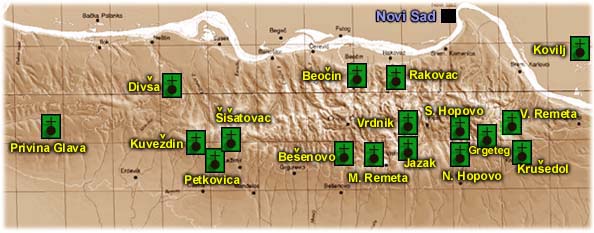
This post belongs to the series about the beautiful monasteries of the Fruska Gora (the only mount of the extended flat Vojvodina region in the National Park of Fruska Gora which is also a well know tourist destination).
This unique place lays between Novi Sad and Belgrade Airport and makes a good day trip (by car).

The links to the first 7 monasteries of the series (Velika Remeta, Novo Hapovo, Krusedol, Jazak, Beocin, Vrdnik-Ravanica and Grgeteg) are on the bottom of this post.

Here are a few others of the 15 preserved monasteries of the Fruska Gora National Park.

The Privina Glava Monastery (Манастир Привина Глава)

The monastery church is dedicated to the Council of the Holy Archangel Michael. According to the legends Privina Glava was founded by a man named Priva, in the 12th century. The monastery was named after him, so the tradition says. The legend also links the monastery to Jovan Brankovic (burried in Krusedol Monastery) and his brother, Bishop Maksim, who founded the monastery in 1496. The first documented evidence of Privina Glava is rendered by Turkish tax records of I566-67. The Monastery church is a single-dome structure with a trefoil base built between 1741 and 1760, after the model of the Novo Hopovo monastery church. The monastery residences were built on the South and partially on the East side of the church, between 1753 and 1771. The so-called zoograph icons on the old iconostasis were painted by Stanoje Popovic in 1747. The icons on the new iconostasis were painted by Andre Sartist in 1786. The murals in the central part of the church were made by Kuzman Kolaric between 1786 and 1791.


The Petkovica Monastery (Манастир Петковица)
The monastery church was dedicated to St. Petka. According to the tradition, founded by the widow of Stefan Stiljanovic (burried in Sisatovac Monastery), despotess Jelena. The monastery is first mentioned in Turkish documents of 1566-67. The church has a trefoil ground plan that has still been preserved, except for the wooden bell-tower, which was replaced in the mid-18th century. The fresco paintings, a good portion of which has been preserved, were finished in 1588. In the 18th century, the church was renovated several times, and in 1735 got a new iconostasis with a large carved cross. During World War II, the church was deserted and the icons carried off and lost forever. The iconostasis was destroyed and the cross moved to the Museum of Srem, in Sremska Mitrovica. The monastery has been partly renovated.


The Sisatovac Monastery (Манастир Шишатовац)
The monastery church is dedicated to the Birth of the Mother of God. The foundation of the monastery is ascribed to the refugee monks from the Serbian monastery of Zica who tore down the original church of St. Nicholas called Remetsko, and erected on its site a new church, which was dedicated to the Virgin, and named Sisatovac. The reliable facts illustrating the life of the monastery date from the mid-l6th century. In 1543, the relics of St. Stefan Stiljanovic were brought from Siklos to the monastery. The old two-domed church, which had been built by masters from Adriatic coast, Jovan and Gaspar, was destroyed in 1778. A new, larger one, donated by the bishop Vikentije Jovanovic-Popovic was built on its site. The monks' quarters were erected on three sides, while the fourth was closed by the church itself. The quarters acquired their present appearance at the beginning of the 19th century. The cemetery chapel was dedicated to St. Paul and St. Peter, and the chapel was built in 1750. The iconostasis and murals for the new church were made by Grigorije Davidovic-Obsic, in 1795. The monastery was destroyed during World War II. The reconstruction of the monastery is under way.


The Rakovac Monastery (Манастир Раковац)
The monastery church is dedicated to St. Cosmas and St. Damianos. According to a legend written in 1704, Rakovac is the heritage of a certain man, Raka, courtier of despot Jovan Brankovic. The legend states that Raka erected the monastery in 1498. The monastery got its name after him. The monastery was mentioned in the first Turkish census of Srem in 1546. The addition of a baroque bell-tower on to the West church facade, in 1735, entailed certain changes in the trefoil shape of the church and the whole monastery complex. The monks' quarters acquired their final appearance in 1771, surrounding the church on three sides. The church was supposed to be painted at the beginning of the 16th century. The only preserved parts of the frescos are those in the tambour of the dome. The icons on the baroque iconostasis were done by Vasilije Ostojic in 1763. The single-nave chapel in the monastery graveyard dedicated to the Shroud of the Mother of God, built in 1751, houses the iconostasis painted by Janko Halkozovic and Vasilije Ostojic, in 1755. The monastery was severely damaged in World War II and a lot of cultural, historical, and artistic valuables were irretrievably lost. The church has been reconstructed.


The Staro Hopovo Monastery (Манастир Старо Хопово)
The monastery church is dedicated to St. Pantelemon and was built in 1752. According to the tradition the monastery was founded by bishop Maksim. The first reliable data about the monastery date back to 1545/46. There are no records about Staro Hopovo from the 17th century and the first half of 18th century. According to some records before there was a church devoted to St. Nicholas, with walls made of wooden planks. Instead of that church, which was destroyed in an earthquake, the present one, dedicated to St. Pantelemon was errected. In the new, single nave domed church, the throne icons, on the baroque iconostasis, were painted by Janko Halkozovic.
During World War II, the church was damaged and the iconostasis was dismantled. The church itself underwent conservation and restoration after the World War II. The monastery is not anymore in use.

My Travel Posts about the other monasteries:
Fruska Gora Monasteries Overview 
Velika Remeta Monastery in Fruska Gora
Novo Hapovo Monastery in Fruska Gora
Krusedol Monastery in Fruska Gora 
Jazak Monastery in Fruska Gora
Beocin Monastery in Fruska Gora
Vrdnik-Ravanica Monastery in Fruska Gora
Grgetec Monastery in Fruska Gora

Picutres and texts in part from SPCO Lucern and pravoslavlje.nl

May 7, 2012

Grgeteg Monastery in Fruska Gora


This post belongs to the series about the beautiful monasteries of the Fruska Gora (the only mount of the extended flat Vojvodina region in the National Park of Fruska Gora which is also a well know tourist destination). The links to the first 6 monasteries of the series (Velika Remeta, Novo Hapovo, Krusedol, Jazak, Beocin and Vrdnik-Ravanica) are on the bottom of this post.

The Grgeteg Monastery (Манастир Гргетег).

The Grgeteg Monastery, with the church dedicated to Saint Nicholas and located on the southern slope of Mount Fruška Gora, was, according to a legend, built in the mid-fifteenth century by Despot Zmaj Ognjeni Vuk for his father, Grgur the Blind. The earliest historical data related to the Monastery are encountered in Turkish defters from the mid-sixteenth century.
Although prior to the Great Migration of Serbs it had been forsaken, its refurbishment took place in the beginning of the 18th century through endeavors of the Metropolitan Isaija Đaković. The baroquization of the church was undertaken between 1766 and 1771, during the Metropolitan Pavle Nenadović. 
Extensive refurbishment from the time of hegoumenos Ilarion Ruvarac, undertaken in the late 19th century, was supervised by an architect from Zagreb, Herman Bole. 
The older iconostasis, painted by Jakov Orfelin, was replaced by a smaller screen, whose author was Uroš Predić, executed in the style of academic realism. The Grgeteg Church is a single-nave building, with a round altar apse and rectangular choirs. The 18th century dome was removed during the last refurbishment, which insisted on a clear layout and symmetry, both in the interior of the church and on its façades. 
The monks dwelling quarters surround the church by all four sides. They originated during the Metropolitan Pavle Nenadović, in whose time a campanile—to be pulled down in WWII—was also erected. In the same period the iconostasis in the campanile chapel was destroyed, painted by Pierre Križanić. Systematic reconstruction and conservational works were begun in 1953.

(The text,slightly adapted, and the cover picture are from Spomenici kulture u Srbiji)  

Travel Tips:
Fruska Gora Monasteries Overview 
Velika Remeta Monastery in Fruska Gora
Novo Hapovo Monastery in Fruska Gora
Krusedol Monastery in Fruska Gora 
Jazak Monastery in Fruska Gora
Beocin Monastery in Fruska Gora
Vrdnik-Ravanica Monastery in Fruska Gora

May 2, 2012

Vrdink-Ravanica Monastery in Fruska Gora


Going on with the series about the beautiful monasteries of the Fruska Gora (the only mount of the extended flat Vojvodina region in the National Park of Fruska Gora which is also a well know tourist destination). The links to the first 5 monasteries of the series (Velika Remeta, Novo Hapovo, Krusedol, Jazak and Beocin) are on the bottom of this post.

The Vrdnik-Ravnica Monastery (Манастир Врдник-Раваница).

The Vrdnik-Ravanica Monastery, with a church dedicated to the Resurrection of Christ, was built in the 16th century on the southern slopes of the Mount Fruška Gora. In a Turkish defter, it is mentioned as the “Monastery of Saint John nearby helmet Vrdnik.” After the Great Migration of Serbs in 1690, it was populated by monks from the Ravanica Monastery near Cuprija, and ever since has often been referred to as the “Ravanica of Srem.”

The monks from Ravanica had to flee from the Turks in order to safeguard their treasures and the holy relics of Prince Lazar, so they found this place where they renovated the Vrdnik Church, changed its dedication, and reestablished the cult of the Prince Lazar.
A bigger church was built in 1811, during the Metropolitan Stefan Stratimirović, whereas on the site of the smaller church, a stone cross was placed. Based on the project of Kosta Zmijanović, the work was undertaken by Kornelije Srbin from Novi Sad. It is a single-nave building of large dimensions, with a small dome conspicuously out of scale with the rest of the edifice, a round apse and rectangular choirs. Soaring above the narthex with the choir gallery is a three-storied baroque campanile. Façades are enlivened with pilasters topped by classical capitals and large, rounded window openings.


Frescoes, executed in the spirit of Romanticism, are work of Dimitrije Avramović, who also painted the iconostasis. Lavish and assorted woodcarving of the iconostasis, characterized by pronounced symmetry in tune with the classicist spirit, was done by Marko Vujatović. The most elaborate restoration in the post-WWII period was undertaken between 1987 and 1990.

(The text,slightly adapted, and the cover picture are from Spomenici kulture u Srbiji)  

Travel Tips:
Fruska Gora Monasteries Overview 
Velika Remeta Monastery in Fruska Gora
Novo Hapovo Monastery in Fruska Gora
Krusedol Monastery in Fruska Gora 
Jazak Monastery in Fruska Gora
Beocin Monastery in Fruska Gora

April 20, 2012

Beocin Monastery in Fruska Gora


Going on with the series about the beautiful monasteries of the Fruska Gora (the only mount of the extended flat Vojvodina region in the National Park of Fruska Gora which is also a well know tourist destination). The links to the first 4 monasteries of the series (Velika Remeta, Novo Hapovo, Krusedol and Jazak) are on the bottom of this post.

The Beocin Monastery (Манастир Беочин).

The Beočin Monastery, whose church is dedicated to the Resurrection of Christ, lies on the northern slope of Mount Fruška Gora, near the road to Beočin. Its history can be traced back to the mid-sixteenth century, when the Monastery was mentioned for the first time in a Turkish defter. 


Under Arsenije III Čarnojević, it was renovated by monks of the Rača Monastery. Construction of today’s church begun in 1732, and it was enabled through donations of Milivoje Milaković from Futog, and his son Petar from Gložane. The church was completed in 1799, when the baroque crown was placed on top of the belfry.


The church (post Byzantine style with Moravian influence) of the Beočin Monastery was designed as a single-nave, elongated building, whose altar apse is seven-sided on the outside, and semi-circular on the inside, and with rectangular choirs.
The high, octagonal dome is supported by four free-standing pillars. Above an open, arcaded and rib-vaulted porch, soars a two-storied belfry. The western façade of the church is dominated by the stone portal with sculptured frame.


The high, lavishly gilded baroque iconostasis is the joint work of Janko Halkozović, Dimitrije Bačević and Teodor Dimitrijević. The fresco painting is, unfortunately, almost completely destroyed, save for the scene of the Dormition of the Virgin on the north wall. The church of the Beočin Monastery is on its southern and western sides enclosed by monks’ dwelling-houses, which were eventually joined together in 1765. Systematic restoration of the Monastery complex was begun in 1986.
(The text,slightly adapted, and the cover picture are from Spomenici kulture u Srbiji


Travel Tips:
Fruska Gora Monasteries Overview 
Velika Remeta Monastery in Fruska Gora
Novo Hapovo Monastery in Fruska Gora
Krusedol Monastery in Fruska Gora 
Jazak Monastery in Fruska Gora