Showing posts with label travel tips. Show all posts

July 18, 2013

Travel tips for Serbia 2013


When I decided to travel to Serbia for the first time (that's quiet a long time ago...) you could not find ANY advise for travelling there, but just recomendations to NOT go to that area of the world. The war was over, the NATO agression fresh in the back an internet was not yet sharing many links regarding that area.

Today it's easier, tourism is wide spread also in Serbia and even less informed people know that the entire Balkan region is not only of a stunning beauty but also a safe place to explore and makes it also a good and cheap place for simply spending a vacation.Of course you can just jump into a plane and land in the middle of Belgrade and have a perfect stay without even knowing where you are. 

The advise I'm giving here, is for a traveller like me, the one that enjoys the preparations and getting inspired for the journey as much as the travelling itself!

If you wish to have the best of the Serbian experience, here my advise:

Preparations for visiting Serbia


1. read something about serbian history


Serbia is a country with an important history and everything you see is loaded with history! So I suggest to read at least this historic summary, that will put the things you see in the right historic contest.


2. learn the serbian cyrillic alphabet

Learn to read cyrillic characters or at least print this cyrillic alphabet out and carry it with you. Most of the signs are written in cyrillic, however in Belgrade and where big communities of hungarians (in northern Vojvodina province) or albanians (in Kosovo and Metohija province) live, you'll find a lot written also in the latinic alphabet.


3. learn about serbian cuisine


The Serbian eating style is something that delights tourists the most: it's absolutely fantastic! In this overview about serbian food you find an explanation to all the dishes served in restaurants, a good guide to drinks and eating habits. (For vegetarians, well what to say? if you decide to eat meat once in your lifetime, do it in Serbia...)

Since the food is so good you might come back from Serbia and have the wish to cook the nice things yourself. So here my 4 favorite links to serbian recipes:
astal - Vera's recipes from the Vojvodina region
palachinka - serbian food in stunning nice pictures
mezze - my favorite cooking magazine from Serbia (my favorites are the ethno recipes in each issue)

moje grne - The vaste recipe collection from Dragana from Bor

Љубав на први залогај - the recipes from Dragana from Belgrade

kad ja kuvam - Irena from Montenegro has good recipes with great pictures


Formal matters for Serbia

Here some general information to get the administrative things right when entering and leaving Serbia. It's not complicated, but it's nice to have it here all in one place:

French embassy in Belgrade (vis-a-vis Kalemegdan)

1. Here a list of all foreign embassies in Serbia (listed by countries)


2. Here is an overview for Visa regimen with the list of countries
Foreigners should register their arrival in Serbia (if you're staying at a Hotel, they will do that automatically for you) with the competent authorities (according to the place of residence of the foreigner - the police department). It's not a big deal and it doesn't cost much (a couple of cents for the papers).


3. It's never a bad idea to check border customs (here an overview) As a tourist you shouldn't have any troubles with customs officers. Be just sure to get an "Entrance to Serbia stamp" in your passport, that will avoid troubles when travelling out of the country again.


That's what I usually bring out of Serbia! 


General advise for Serbia

1. It's forbidden to take pictures of any military facilities.


2. Don't panic if you read some bad facts about Serbia.It's still some anti-serbian propaganda going on, and whatever unpleasant happens in Serbia is displayed as a big thing in western european medias (there are however some sites, like at de-construct and Serbia's Ambassador to the world oposing against that). Remember that statistically it's more likely you happen to get harassed in a western european city that somewhere in Serbia. Be respectful and you get respected!


3. Stay out of politic debates and go easy on spreading your opinion about themes like Balkan Wars, religion, Kosovo and gay-parades.
In the entire balkan region people are still very sensitive about war themes and if you're not part of them you can not 100% understand it. So keep the good advise for your diary and not for the table at the local Kafana. If you are interested in following politics in Serbia (and it's really entertaining) here an overview of the political parties, their leaders and their ideas.After these more general links, the next few posts will be about 4 itineraries to discover Serbia.After these more general links, the next few posts will be about 4 itineraries to discover Serbia.

With these basics you just need to get your itinerary and depart!

Ideas for itineraries in Serbia:

Travel tips for Belgrade
Travel tips for Kosovo and the Raska region
Travel tips for Tara National Park and Kopaonik
Travel tips for Ethno Villages in Serbia
Travel tips for Fruska Gora Monasteris

Stara Planina (the old mountains -heart of the balkan)
Vranje (the city of Bora Stankovic)
Sremski Karlovci (beautiful town at the border of Fruska Gora National Park)
Zasavica Nature Park (Nature, Ethno, Food, Culture)


April 6, 2013

Stara Planina Mountains

Stara Planina

The Stara Planina (that means old mountains) is a part of the Balkan mountain range and lays in Eastern Serbia on the border with Bulgaria. The Balkan range runs 560 km from Vrška Čuka Peak on the border between Bulgaria and eastern Serbia eastward through central Bulgaria to Cape Emine on the Black Sea.

The Stara Planina is remarkable for its flora and fauna, and also with steep cliffs, the highest waterfalls in the Balkan peninsula and lush vegetation. 

Geologically, the Balkan Mountains is a 'young' part of the Alp-Himalayan chain which stretches across most of Europe and Asia. 


It can be divided into two parts: the main Balkan Chain and the Pre-Balkans to the north, which intrude slightly into the Danubian Plain. 


On top of the Serbian part is this rock called "Babin Zub" (Grandmother's Teeth).


The surrounding are part of a ski recreational area in winter and full of nice hiking trails in summer.


I just took a few pictures while cruising around. I arrived by night at Babin Zub's Hotel after a drive through dark roads and the navigation telling that theres nothing further along. I really had no idea were I landed. 


The next day I was surprised with a nice scenery while driving to see the newly errected just opened Hotel Stara Planina.


Also the new Hotel was a pleasant surprise, instead of an overstated giant facility with no relation to the surrounding, the building looks solidly adapted to the rough mountain setting from the outside and the interior is appropriately stylish.


After visiting the area in summer, I now would like to visit the area in winter. 

Eastern Serbian mountains are as beautiful as the Western Serbian mountain (I wrote about those mountains here in my posts about the unique National Park Tara "Best travel tips for Serbia - TARA/KOPAONIK" and "Tara National Park in Western Serbia", the Ethno Village Sirogonjo "Etno Selo - Sirogonjo", the posts about the Zlatibor region: "More Ethno in Zlatibor", "Mokra Gora" and Ethno Village Mecavnik "Kusturica made it!".


March 28, 2013

Temska a beautiful village of eastern Serbia

Temska

While traveling through Eastern Serbia I particularly loved some of the characteristic and soulful villages driving along smaller roads. Those villages are far enough from urban centers so they're totally quiet, but still near enough to benefit from trade oportunities and public infrastructure the cities can offer. Temska is one of those really picturesque villages without being too glamed up.  


Typical example of moravian style rural houses in Temska

 beautiful barns, traditional wood construction

Temstica river
 With around 900 inhabitants, a ground school, postal office, a few stores and a coffee shop it looks like a lively neat place along the Temstica River (a affluent of the Nisava River). 

Beautiful wood constructed barns with tile roof (and a couple of goats on Temska's streets)


Near the settlement there is a small hydroelectric plant and the small Monastery dedicated to the Holy Martyr Saint George called Temska Monastery.


Erected on ruins of a fortification of the 11th century, the monastery was built in the second half of the 16th century by the Dejanovic Family (nephews of Tsar Dusan).
 The Konak (Guesthouse) is beautifully restored

 The monasterie's dormitory and living quarters built in the 18th century represent an excellent example of the local folk architecture 

On the porch of the building various natural balm and balsams with curative effects and produced in traditional way from medicinal herbs of the Stara Planina are sold. People stop by to buy such balms for curing eczema, psoriasis, dermatitis, neurodermatitis, atopic dermatitis, skin allergies, acne, burnt skin, insect bits, hemorrhoids, varicose veins, alopecia, sinusitis, inflammation of the ears and open wounds. 


The Temska Monastery church has a three-nave basis with a semicircular altar apsis and a low eight-sided dome. The monastery church itself was constructed of white stone and covered by stone layers. In 1654 a vault was added above the narthex instead of the old wooden construction and the porch was painted with beautiful frescoes.

Iconostasis of Temska Monastery Church

 Temska Monastery cimetery


To give you some more information on village architecture in Serbia I post the links of my 6 Lessons on Serbian Rural Architecture

Lesson 1 in Traditional Serbian Rural Architecture
Lesson 2 in Traditional Serbian Rural Architecture:Style by Regions
Lesson 3 in Traditional Serbian Rural Architecture: The South Serbian Village
Lesson 4 in Traditional Serbian Rural Architecture:The Family Homestead
Lesson 5 in Traditional Serbian Rural Architecture: The Moravian House and its Interior
Lesson 6 in Traditional Serbian Rural Architecture: How does "new" rural architecture looks like?

March 16, 2013

Donkey Cheese from the Zasavica Nature Park in Serbia

From this donkey comes the most expensive cheese in the world

When I visited the famous Serbian wildlife and nature reserves Zasavica one year ago while visiting Sremska Mitrovica (my post about it here) I didn't know that the world's most expensive cheese, made of donkey milk, is produced there!

I read here that the Nr.1 tennis player Novak Djokovic is buying an entire year production of this cheese to make it one of the key attractions at a chain of restaurants the Wimbledon champion and world number one is opening in his Serbian homeland.

Beside this interesting cheese story, Zasavica Park is indeed worth a visit. For all traveller who enter Serbia by the Zagreb-Beograd speedway Zasavica is on the road and makes a nice stop. 


Mangulica Pig

Mangulica is the only surviving autochthonous Serbian breed of domesticated pig. Other two, Šiška and Šumadinka died out. A breed, also known as "woolen pig", due to its good qualities, is considered a "noble", but it almost died out in the 1980s. 
Its fat has up to 80% less cholesterol and triglycerides than a common, white pig. In 1998 Mangulica was introduced in Zasavica, and are left to roam free in the reservation.

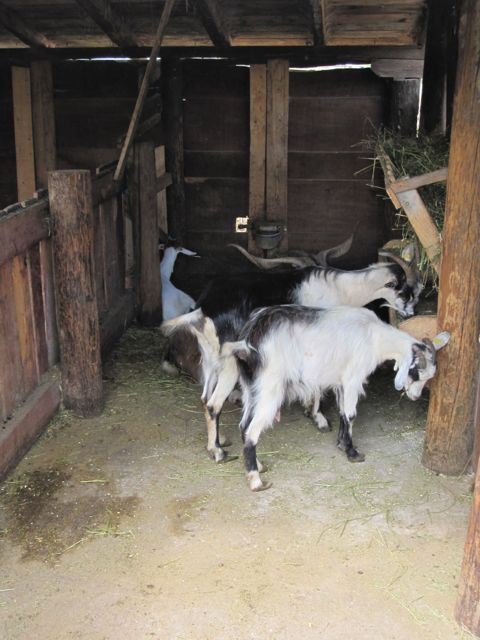
Goats


Sheeps

 
Agriculture:  
The concept for Zasavica Nature Park ist that Agriculture helps local farmers to gain income from the reserve and at the same time it is an essential tool for the management of specific habitats and species. Agriculture is restricted to grazing and hay making and famers are not allowed to use of pesticides, herbicides and chemical fertilizers. Preferably farmers use domestic cattle typical for the region like the Manguliza pig and Podolian cattle for grazing. 


Cattles

Podolian-Cattle 

In 1998 the cattle of the Podolian breed was introduced in Zasavica. First animals arrived in the spring of 1998 from Mionica, in western Serbia. Pasture "Valjevac", near the small Goransko-ribolovačko lake was chosen as their home. The pasture has an area of 3 square kilometers and today numbers 50 cattle. Breeding of Podolian cattle is being part of the program for the preservation of the animal species, developed by the Serbian Ministry of agriculture.


 Ethno architecture from Srem Region and Vojvodina


Biodiversity
In this habitat types and species (including meadows and pastures, open water, marshes, wet forest patches and upwelling water springs) of European and Serbian importance are settle here and live in a favorable conservation status. 

 
Educational program for schoolchildren, educational work camps and research camps are being organized with the purpose of increasing the awareness and knowledge on value and importance of protecting the wetland in general and Zasavica wetland in particular.


Here the official Website of the Zasavica Nature Park


October 3, 2012

Architecture in Zajecar, Eastern Serbia

Zajecar is best known for culture, music and sports and its best value is probably the nearby Gamzigrad archeological site. So I wasn't expecting much from the city's architecture. However I was pleased to find some interesting modern buildings from the 60's and 70's in the very town center. Only a few roads away the city looks picturesque with older houses with two to three stories in warm earthy colors and a simple neoclassical style.

I took pictures of the modern buildings in the center, like this highrise building in beige, olive and brown ....
.... with its decorative fire escape stairs

 70's buildings on the way to the center

 60's architecture for the E.D. Jugoistok(electro public supply of south-east Serbia)

80's/90's buildings with asymmetrical terraces and bulging decorations

The typical "Beograd" Chain-Store in the center (I wrote about this retail-chain here)

The new facade .....and below how it looked in the past
previously this facade was in a bronzed color


This building is not an architectural highlight: ugly proportions, random postmodern details and an off-key roof make it an unattractive landmark near the main square. This building is home to Hotel "Srbija Tiš" and although it's not a pleasure from the outside, to do justice I should mention, that the interiors are spacious and renovated and they look quiet sophisticated. Thanks to the position there is also a great view from the hotel rooms.

Some impressions of the main square: the police station ...
... the national museum on the right ....
...the monument to its famous citizen: Nikola Pasic 

More posts about Eastern Serbia:
www.sajkaca.blogspot.ch/2012/09/modern-pirot-buildings.html
http://sajkaca.blogspot.ch/2012/09/traditional-pirot-ponisavlje-museum.html