August 30, 2010

Lesson 1 in Traditional Serbian Rural Architecture


The reason I researched information about traditional rural houses (seoske kuce) in Serbia, was a personal one: my husband and I wanted to remodel his old family house in a village in the south of Serbia.
But for me, only if I understand the principle of the past I can apply them in a contemporary way. And also only if I understand the regional peculiarities I can transform an old house into a modern one that blends perfectly with the surroundings.


Basically the rural type houses have two typical images: there is the log-cabin (mostly in Western Serbia) called "брвнара" (brvnara, from brvno = log) and the cottage with mud-filled walls (all over Serbia) called "бондрука" (bondruka). Then there are mixed forms of these two basic types.


The way of construction and how the buildings and rooms were disposed, based on the experience of the farmers and how the farmers household was organized. The architecture was deducted from the form of living, and this was very close and dependable from nature, weather and the characteristics of the area.
So the building were strictly functional and the used material was what the pheasant could find in his surrounding:
wattle of reef, wood or straw for fillings of wooden framework and wood-shingles or tiles to cover the roof. Then according to climatic conditions, the materials may vary.


The ”брвнара” (brvnara)

This is the oldest type and also the rarest form: the log-cabin. It's a one-room rectangle building, built directly on the ground or on a flat base of rubble stones (mostly when the terrain is steep). The tented or hip roof (four sides) is steep and covered with wooden shingles. The eaves come down very low and cover most part of the windows and protects them from weather.


The typical of the log-cabin is that the walls are massive and full. The logs can be round or squared off.


Vuk Karadzic's house in Trsic (here my post about Trsic)
 
An open fireplace is located in the center. Usually there are two doors on oposite sides. Тhe floors are of stomped earth and the ceiling is open to the roof. Windows are just small vents in the logs, that will be closed with wood or transparent leather in winter.

These log-cabins were used for living or overnight-stay in the woods, today it's still used for weekend-houses in the mountains.


Бондручна конструкција испуњена чатмом
(The Bondruka Wall is a wooden skeleton filled with mud)

The "бондрука" (bondruka)
Tis is the most popular rural house in the Balkan region and is a further progress of the log-cabin. The construction is of wooden skeleton walls filled with mud and reef and plastered with mud on the outside and with plaster on the interior walls.
Also here, on steep terrains the cellar is made of stones to level out the differences in height. 


There is always a hiproof (4-sided roof) and it's covered with slightly curved roof tiles.


A typical Bondruka with Stone basment 
and plaster-covered skeletton-walls of wood and mud


Lesson 2 in Traditional Serbian Rural Architecture will be about the most typical regional styles of village type houses.


August 22, 2010

Banjska Monastery in Kosovo and Metohija


Another meaningful monastery in Kosovo and Metohija is the Banjska Monastery near Zvečan a little town not far away from Kosovska Mitrovica and near the river Banjska.

Most of the monasteries of Northern Kosovo ( I wrote already about another North Kosovo Monastery: Socanica) are save and do not need military protection, because the main population in the area is represented by Serbs.
However it's very important to preserve the monasteries and to keep the Serb population in the Holy Christian land of Kosovo and Metohija, because, as emphasize Bishop Artemije:

"As long as we are physically present in Kosovo, it will remain ours. If, God forbid, we should disappear from this region, Kosovo would not be Serb even if it remains within the borders of Serbia. We don't need Kosovo without Serbs. Therefore, we must persist and persevere in hope and salvation and remain in our land. And those of us who were forced to leave from Kosovo and Metohija must return as soon as possible so that God can administer to our entire people"


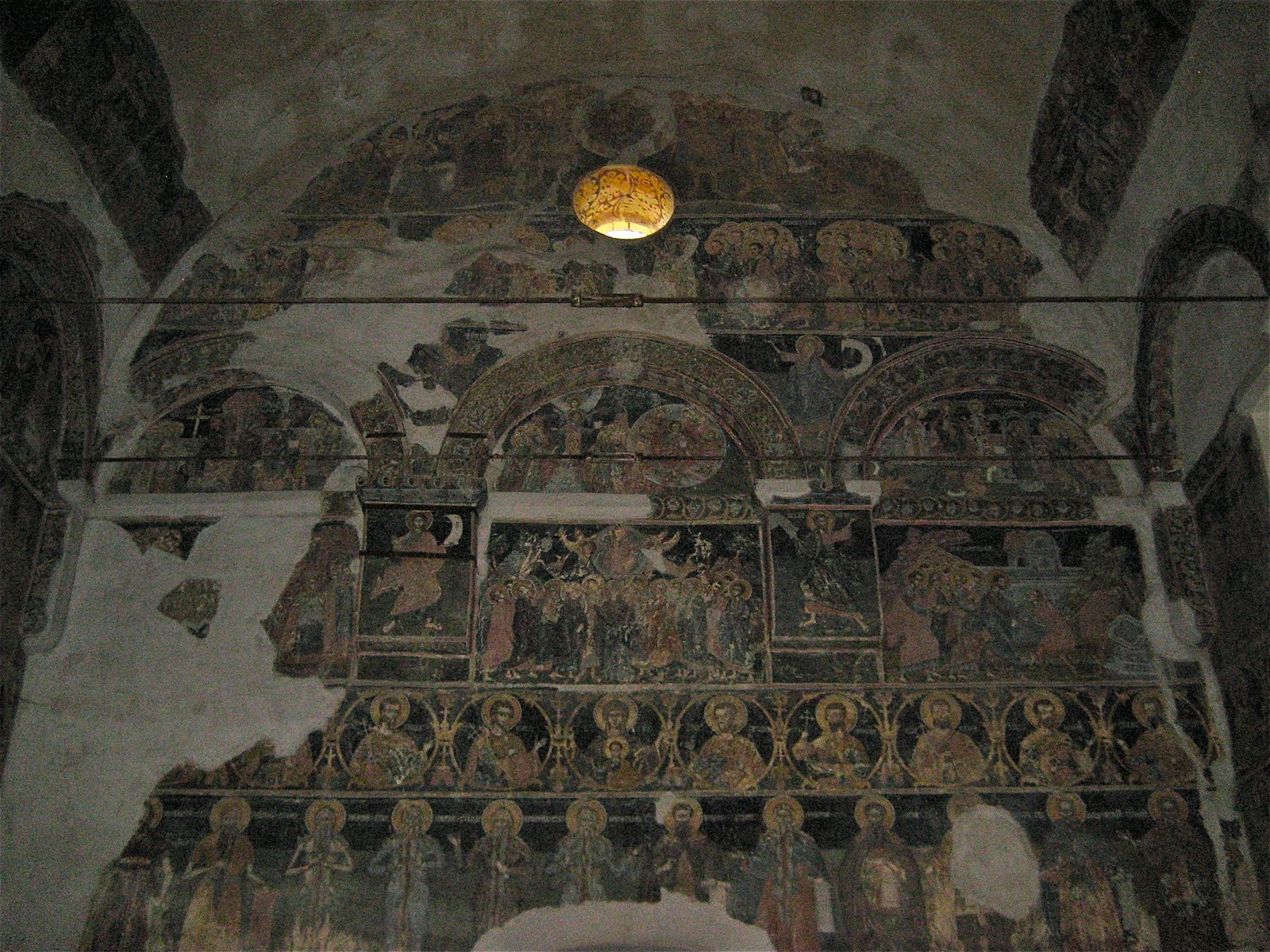
This monastery with the St. Stephen's Church was built between 1313 and 1317 and was founded by the Serb King Stefan Uroš II Milutin, one of the most powerful Balkan rulers of the period and one of the most powerful rulers of the entire Nemanjić dynasty.
King Milutin built the church as his burial place and it is there that he was first laid to rest. However, following the Battle of Kosovo in 1389 his body was moved to Trepča (also near Kosvoska Mitrovica) and then in 1460 to Sofia, where it lies today in the Alexander Nevski Church.


The monumental building with its church, the library, the monks' quarters and the "imperial palace" began to fall into disrepair very early. At the beginning of the 15th century, a fire destroyed the library and in the second half of the same century the monastery was probably abandoned. 
So its formerly style similar to Studenica (Raska School) is not anymore recognizable.
Kuprešić, an author writing about his travels, mentions that the monastery was razed to the ground in the 16th century on the orders of the Sultan of the Ottoman Empire, because it served as a shelter for Christians who had fled Turkish slavery. There the Turks used it as a mosque.

The facade decoration was made in chess-board style with different colored marble stones. The Romanesque tradition is enforced in combination of rich architectural encrusted fragments of the portal termination, doors and windows consoles. 
Churche facades in marble where held only for Kings, and Milutin wanted to emphasize this. 


In the 19th century the almost totally demolished Church of Banjska Monastery was used as a mosque where Islamic prayers were performed until the First World War. Architect Dj. Boskovic took some preservation and reconstruction works in 1938.
In the 1990's some renovation works were started and in 2004 when a Liturgy was held by Patriarch Pavle and Clergy accompanied with many faithful people. Since then it's a working monastery again and a monastic brotherhood moved in  and was consecrated by Bishop Artemije (Radosavljevic) of Raska and Prizren with the clergy and monks of the Diocese of Raska and Prizren.
The church is an one nave basilica covered by a blind vault. 
The eastern semicircular apse was monumental and the western entrance (narthex) to the church was built in accordance to the Raska ecclesiastical style of monuments with two large towers.
The katholikon served as exemple for later built monasteries in the surrounding like Visok Decani and Sveti Arhangel and also for later churches of the moravian school.
The choice for a Raska School Style architecture in Banjska shows how the Nemanjic Family was closed to tradition (King Milutin experimented with several styles for other monasteries, but for his burrial site he wanted a clean traditional Raska School exemple).

Here the icon of King Milutin as a saint

Banjska Monastery was declared Monument of Culture of Exceptional Importance in 1990, and it is protected by Republic of Serbia.

A good way to visit this monastery (and some of the most beautiful monastery of Kosovo and Metohija) is the 7-days tour through Kosovo and Metohija with "Spiritualserbia" , Nemanja's guided tours with focus on religion, history and architecture.


 This Photo by Peter Vanderbiesen


July 27, 2010

Belgrade Sweet Souvenir by Coba Associates


It's not the first time I mention  Coba & Associates a Belgrade based Design. I wrote about their very inspiring publication LIVING BELGRADE not long time ago here.

Now I stumbled upon a cool page called "lovely package" just to find again some great work of Coba!

They created outstanding packages for quality Serbian chocolate ADORÈ. (I didn't even know it until now!)

In a collection of 6 flavors created by ADORÈ and packages created by Coba they put together little pieces of beautiful art!

BG ČO-KO (a black chcolate with dried cherries) got an award for sweet Belgrade souvenir: it's packaged in a city map with a stylish Belgrade-numberplate (read: tcho-kho as chocolate)


 That's my favorite!!!

And here the presentation from lovely packages:

Designed by Coba & Associates | Country: Serbia
“Adoré are hand-made chocolates and as such fall under the category of higher quality status both in terms of product quality and packaging design, as well as consumer communication. Bearing in mind the active period in the development of the brand, we needed to create packaging for a new product – the chocolate tablet. The idea was to come up with packaging for 10 different flavors.
Each flavor got its own look and name! Whether it is Crunchy Mint or Orangella, each flavor received a specific packaging which are (from a production standpoint) very specific in this region. Using thermal block foil, laser-cut paper and special printing techniques have resulted in designs that communicate that Adoré Chocolate provides more than just taste – it is a brand that takes you on a journey.”


Social Bookmarking


    Bookmark to: Digg
        Bookmark to: Del.icio.us
        Bookmark to: Facebook
        Bookmark to: Reddit
        Bookmark to: StumbleUpon
        Bookmark to: Yahoo
        Bookmark to: Google
        Bookmark to: Technorati
        Information
       

June 27, 2010

Fruska Gora Monasteries

Krusedol Monastery

The Northern part of Serbia is called Vojvodina Region and is part of the Pannonian plain of Central Europe. The only mount in this extended flat region is the National Park of Fruska Gora which is also a well know tourist destination, and thanks to his hospitable and fertile environment around 35 monasteries were erected between the 15th and 18th century (some monasteries dates even from earlier time) in an area of 50 x 10 km.

 Krušedol  Monastery (Крушедол)


These monasteries were repeatedly protagonists of the history of the Serbian Nation, as pilgrims and refugees found places during time of persecutions. They were among the focal points of resistance against the Ottomans and also places of storage for treasures of orthodox spirituality and art over the centuries.

Today there are just 15 monasteries left and some of them were damaged during the NATO bombing campaign in 1999.
So now Fruška Gora Monasteries were declared Monuments of Culture of Exceptional Importance in 1990, and they are protected by Republic of Serbia.

Velika Remeta Monastery  (Велика Ремета)


Novo Hopovo Monastery (Ново Хопово)


Nemanja from SpiritualSerbia (a company that organizes trips to Serbian-orthodox monasteries all over South-East-Europe) gave me some pictures of the beautiful Fruska Gora Monasteries and explained the most important facts for visiting Monasteries in orthodox countries.
Nemanja tells that the monks in Serbian orthodox monastery are not really strict about behavior of visitors in the monastery, as they assume that if you dress not adequate and behave rather rude, that you’re not doing it on purpose, but that you just don’t have a clue about the rules. However it’s nice to show you arrive prepared and are willing to show your respect for their holy place.

Jazak Monastery (Јазак)


Here some tips for visiting monasteries:

Apropriate clothing: For men it’s long trousers and closed shoes, and no head coverage. For woman it’s a long skirt, long sleeves and a headscarf.

Greeting the monks: Walking toward the monk (or monks) you can nicely say:
"pomaže bog" (literally: That god helps) and he will answer "bog pomogao" (literally: God helps). The monk will then hands you his hand that you will hold in your both hands and bend down your head and tell: "oče blagoslovi" (literally: Father bless me) and he will make a sign to bless you.
 

Of course you don't need to do all that, a simple greeting is fine. The monastery always will send one monk to show you around the monastery and answer your questions. Often you will be invited for coffee and cakes or exquisite monastery rakija. If you want to show gratitude leave some money or in the designated places or simply by the icons in the chapel.


Grgeteg Monastery(Гргетег)


Beočin Monastery (Беочин)


Vrdnik-Ravanica Monastery (Врдник-Раваница)


Nemanja from Spiritualtours proposes nices bed&brakfasts for overnight stays and good ethno restaurants for tasting Serbian Specialties.