February 15, 2012

Air Force Headquarter in Zemun by Dragisa Brasovan

It's not the first time I write about this beautiful building by Dragisa Brasovan, but I'd like to share the pictures I made during a walk through Zemun. 
The building stands empty and unused near Avijaticarski Trg and even if it's really damaged (it was a target of NATO attacks in 1999) it still looks noble and attractive.

Dragisa Brasovan (Драгиша Бршован) finished this building, a large block structure of autonomous character, in 1935. The compositional strategy is to accentuate the strict symmetrical arrangement of the main facade with a prismatic vertical motif.

Some modernist architects criticized this building for its symbolism: the shape in fact is a dual of "Roda" fighter jets with its two wings.

 Air Force Signs and Memorials incorporated into modernist architecture

 Edged corners and a strict fenestration two other details of modernist architecture

 One of the damaged part that was a bit restored. 

A lot of details show Brasovan's good eye for modernist details.

February 8, 2012

Serbian Cyrillic


From the first time I traveled to Serbia many years ago, one of the typical things I loved so much was the cyrillic writing everywhere. Even if it was a bit difficult for me to quickly read things, I wouldn't like to miss it as for me it's a big part of the recognition value of the Serbian ambiance.

Generally in Serbia both scripts, the "азбука" (cyrillic script) and the latinic alphabet are in use and most of the people know both alphabets (Children usually learn first the  "азбука" and the the latinic, but in the end the will know both). People can freely decide which letters to use and often both scripts are portrayed (like traffic signs and street signs).
"Latinica" in serbian means a modified alphabet with 30 letters also called "Abeceda".
In commercial use (especially for export goods) the latinic script is more often used. Also for internet use the latinic comes in handle.

Even if it's now possible to have cyrillic webadresses (instead of the "www" as in cyrillic there is no "w" the letter "њ" (nj) is used) the practice makes it easier to use latinic. However Serbia now got two domain types. .rs and .срб. (You can e.g. try to find the Serbian Television website on the cyrillic domain: њњњ.ртс.срб.)

For official documents (like government files) cyrillic is used (since 2006 the cyrillic writing is the official script in Serbia), and also some of the more traditional an older newspapers like "Politika" use cyrillic. For documents like passports both variantion are offered, as people belonging to other ethnic groups than Serbian (like Hungarians and Albanians with Serbian passport) prefer the latinic version. In the some places of the Vojvodina region, where for example a lot of Hungarians live, the latinic is in wide use (there cyrillic serbian, latinic serbian and hungarian stand together on traffic signs.)


The first known alphabet the Serbs had was called Glagoljica, then the saints Cyril and Methodius with their students developed letters based on the Greek alphabet and made the Cyrillic alphabet.
Still today the Cyrillic alphabet is the official script for the Serbian Orthodox Church.

The cyrillic writing like we know it today was developed in 1818 by Serbian linguist Vuk  Stefanovic Karadzic (Вук Стефановић Караџић).

The ligatures Љ= lj and Њ= nj, together with Џ= , Ђ=dj and Ћ= ć  were developed specially for the Serbian alphabet.

In tourism, cyrillic is used to underline the ethno aspects and activate the traditional emotions. For ethno restaurants and village tourism "cyrillic" is part of the image.

In urban areas, there is a wish to appear international and maybe also the wish to help the tourist to orientatethemselves better. Also the upcomming of more and more international brands make the latinic writing more present.


Recently I was watching the entries for the competition of the Belgrade Water Front Center
an International architecture competition for the new waterfront shaping and design near the historic center that took place in 2011.


I noticed that one of the two 1st entires, a really good work from ARCVS made all the illustration with latinic writings...I was a little surprised as I think that such a tourist landmark should be spelled in cyrillic. I immagine how good a really modern building would look with an adequate cyrillic inscription.


Cyrillic and Non-cyrillic is also often used as a discussion of ethnic affiliation, during the last centuries cyrillic was often forbidden by rulers (as in Austro-hungarian time, later in the kingdom of Serbs, Croats and Slovenes, then in WW2 by the Ustasas again). Keeping that in mind it's understandable that there is an anxiety to preserve the cyrillic. In these days there are forces that do a lot of persuading to turn people to latinic writing, as latinic is seen as modern, practical and EU-friendly. Those forces like to see cyrillic devotees as stubborn and closed minded.

A bit of annoying discussion, the smart thing is to keep both, latinic when it's more practical, cyrillic when identity is in foreground.
Here a discussion between two linguists about this theme.
http://www.politika.rs/rubrike/Drustvo/Srbija-razgovara-Da-li-je-cirilica-zapostavljena.lt.html
Here a great site where you can learn and exercise the "azbuka" and download cyrillic fonts:
http://www.cirilica.com/cirilica/Strane/dobrodosli.html

December 27, 2011

Backa Topola in winter


My best moment of Winter is when I leave Zurich toward South-East and usually I spend much of my stay in Serbia in the Vojvodina region (the flat northern part of Serbia). 
There are a lot of pretty towns that are really worth visiting, and once when my husband showed me where he went to college I had the opportunity to meet Backa Topola (Бачка Топола) a municipality in the North Backa District.(above a postcard from Backa Topola of 1964)
(Backa Topola Postcard from kasina at skyscrapercity)
Due to its favorable geographical location this place was settled from very early on. When in the middle age its inhabitants were all Serbs, after being destroyed by kuruc rebels in 1704, around 1750 it was populated by Hungarians and Slovaks and still today its population is around 60% Hungarians and 30% Serbs (the rest is composed by other ethnic groups).
It's a picturesque town shaped by its austro-hungarian buildings.

Near Backa Topola is a pretty lake called Zobnaticko Jezero (Зобнатичко Језеро). 

There are lots of protected plants, species of insects and birds around the lake, an oasis of nature and peace. 
 
On the other side of the lake are structures for tourism: beaches, a restaurant and possibilities for camping.


The windmill (Vetrenjaca; Ветрењача)

Until 1969 there were more working windmills that were used for grinding corn and wheat. The mill was in the ground floor, the second floor was the apartment of the miller and in the third floor was the mecanism of the mill. Now it's used for museum purpose.

Horse-racing was a popular sport among austro-hungarians, and one of the few racing-tracks of Serbia is located here. Above one of the peculiar buildings at the entrance of the track.

Here the official website of Backa Topola:

November 29, 2011

6 Cool Buildings in Banja Luka


Banja Luka  the administrative capital of the Republika Srpska, is a beautiful town with lots of  interesting buildings from the last century like the Banski Dvor (Бански Двор) (1932), the National Theater (Народно позориште Републике Српске) (1933), The City Hall (Градска палата) (1934), The Palace of the Republic (Палата Републике Српске) (1936) and the buildings on the Promenade - Gospodska street (officially Veselin Masleša street).
(Picture from Panoramio)

What interests me more about Banja Luka are a few modern buildings that I want to show here in this post:

 1. Dom Vojske

 Today it is the National Assembly of the Republika Srpska (Народна скупштина Републике Српске. (picture from panoramio and skyscrapercity)


2. The Retirement Home (Старачки Дом)


 The building looks quiet interesting, it was started in 1989 and it's still not finished.
 (picture from Teča sa Dunava)

3. The Borik Sport Center (Спортска дворана Борик)

This Sport Center is a typical 1970's structured concrete building and lays in the Borik neighboorhood. (picture from wikipedia).


Borik is a neighborhood of Banja Luka. It was built northeast of the old city center after an earthquake in 1969 when Banja Luka was heavily damaged. Borik was planned for housing of people who lost their homes in an earthquake and it was built in a modern socialist architectural style, typical for cities that were developed under an influence of a communist system. (picture from scborik).


The building is from 1974, can seat about 5'000 people and is used for different Sports and for Concerts.

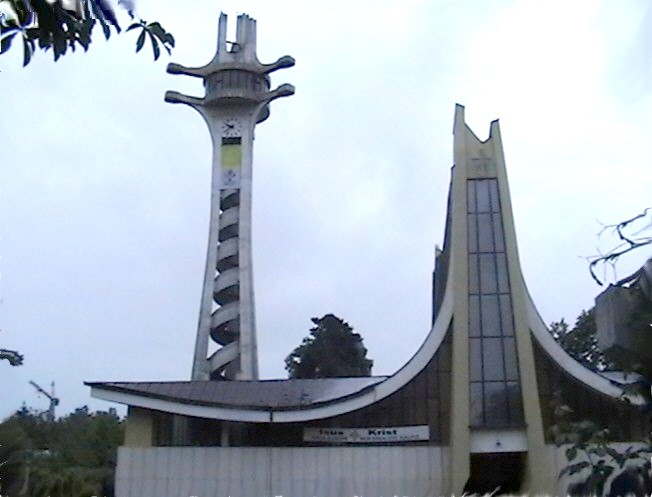
4. The Cathedral of Saint Bonaventure


The Cathedral of Saint Bonaventure is one of four Roman Catholic cathedrals in Bosnia and Herzegovina. The Cathedral was built in honor of Saint Bonaventure, a Franciscan theologian from the Middle Ages. It was constructed by Alfred Pichler in the 1970s after the original had been damaged in the 1969 earthquake.
It was built in a tent like shape. The bell tower was added in 1990.(picture)

5. Boska Shopping Center


“Boska” department store (from 1978) is a building that looks like from outer space. Its shape was designed without any direct formal relationship to the local heritage.

picture by http://www.bojanfajfric.net


It's kind of a landmark of Banja Luka, due to its location (in the very center on a big pedestrian square) and to its over-sized shape. It stands there as a nostalgic symbol of former Yugoslavia and never underwent any changements. (picture from panoramio)

6.  Hotel Turist in Celinac (near Banja Luka)


The last of the 6 buildings is not really in Banja Luka. But with its prefab facade, its round-corner-windows and daring color concept fits into this list of cool buildings.

The hotel has 35 beds and a restaurant. (Pictures from panoramio)


And here a few links for visiting Banja Luka:
Banja Luka Online Guide
• The Banja Luka in your pocket guide to download
  (it's from 2009) but still useful

Here you can download a map of the City of Banja Luka