March 5, 2013

Bukovo Monastery


A couple of kilometers from Negotin, on a forested hill lays the beautiful Bukovo Monastery overlooking villages toward the Dunav River and behind pieces of Romania and Bulgaria. 


The layout of the monastery (source)
 The monastery was founded by Serbian King Stefan Milutin (1282-1321) of the Nemanjic dynasty in the late 13th- or early 14th century.

The church is dedicated to St. Father Nikolaj the Wonderworker and by style is a special variant of the "Moravian School". The church has an elongated shape of a trefoil and was built as a single nave with arched barrel vault and without dome. The narthex was build later in the 19th century.

The wall around the monastery, the belltower and the colonnade were added in the 1930s.


In 2006 two new buildings were erected on the place of the old dorms, which were in ruinous state.

The church interior is richly decorated and in the narthex some frescoes in romantic style made in 1902 by Steva Todorovic shows some members of the Nemanjic Dynasty.


Fresco of Stephen Uroš II Milutin of Serbia (Стефан Урош II Милутин) and founder of the Bukovo monastery


Fresco of Stefan Nemanja (Стефан Немања) 1113 – 1199, Grand Prince of Raska from 1166 to 1196 and founder of the Nemanjić dynasty.


Fresco of Tsar Uros


In this fresco:
Sveti Sava (Rastko Nemanjic) came back from Hilandar Monastery (Mount Atos) to try to make peace between his two older brothers Stefan and Vukan (Stefan as second born was put on the thron instead of the oldest brother Vukan).


Fresco of  Stephen Uroš III (Стефан Урош III) , 1285 – 1331

The monastery has a good website with lots of pictures and information:
http://manastirbukovo.org

February 20, 2013

The Smederevo Fortress


40km south-east from Belgrade lays Smederevo a town of about 100'000 inhabitants and its Byzantine Monumental Complex: the Smederevo Fortress.
I like the setting of this fortress on the banks of the Danube.


Smederevo was the residence of Serbian prince Đurađ Branković and the capital of Serbia from 1430 until 1439, when it was conquered by the Ottoman Empire after a siege lasting two months.

The Smederevo Fortress was modeled after the Constantinople fortress. It's classed as a water fortress and after the fortress' completion, there was a decline in its military importance and few structural changes were made. As a result, the original architectural style has been preserved to this day.


Strategically the fortress is located on the right bank of the Danube river on the triangular plain formed by the confluence of the Danube and Jezava rivers, only 72 meters above sea level. This location allowed the Serbian capital to remain near the Christian Kingdom of Hungary, while also satisfying Sultan Murad II of the Ottoman Empire by eliminating the uncontrolled passage of the Hungarians into the Morava valley.

 The fortress' position connecting the Balkans and Central Europe has made it an important religious and commercial center for centuries.

During NATO agression against Serbia the "Jugopetrol" oil storage depot near Smederevo was bombed several times. Even though the facility is not located in the protected town zone, the force of the detonations and the burning of highly inflammable substances not only endangered the body of monuments in the town center but the strong detonations induced by the bombing caused shaking of the walls of the old town and the Fortress.


The fortress is currently used as a city park, and occasionally hosts cultural events. To the southeast, the previously open space along the Jezava now boasts a harbor. Unrestricted visits by tourists, inadequate protection, no maintenance and lack of strategy and financial resources contribute to the deterioration of the fortress.

The fortress is encircled by 1.5 kilometers of crenelated walls over 2 meters thick, and 25 towers which are each approximately 25 meters tall. 


The throne hall, where Branković received his visitors, was built with four double-arched windows, fashioned in a mixed Gothic/Romanesque style. 
The Donžon kula was intended to be the final line of defense. It was constructed with walls over 4 meters thick, and housed the nobility during Turkish attacks. Hidden doors were built into the Jezava wall, allowing for passage towards Hungary.
In the suburb, a sacral complex was built in phases from the 15th century onwards, and a Turkish bath was added by the Ottomans in the 17th century.
Between 1460–1480, while held by the Ottoman Empire, a larger defensive system was built, including escarpments, low walls, and more towers. During the first half of the 18th century, fortified trenches were added.


1. Main entry gate, 2. City gate II, 3. City gate I, 4. Ship gate, 5. Jezava gate, 6. Flag tower, 7. Turkish inscription tower, 8. Water tower, 9. Outer water trench, 10. Inner water trench, 11. Bridge, 12. Inner city gate, 13. Rectangular tower, 14. Keep (Donžon kula, Donjon tower), 15. Jerina's tower , 16. Despot's inscription tower (krstata kula), 17. Audience/Throne hall, 18. Palace, 19. Bath remains, 20. Church remains


January 16, 2013

Serbian Orthodox Holidays


Whenever I can, I like to celebrate the Serbian Orthodox Holidays in Serbia. Christmas and New Year are 2 weeks later than in the Western Christian World (Serbia follows like Russia the Julian Calender) and are a bit more spiritual and less commercially that its Western equivalent.

 January 6th is Christmas Eve, it's Lenten fast day and traditionally Vegetarian Baked Beans (Posni Prebranac), Pickels (Tursija, Kiseli Kupus), Bread, Nuts and dried fruits are served.
Look here how Christmas in Serbia is celebrated.
 Our family celebrates the family Patron (Krsna Slava) on Saint Stefan's Day (Стефан Првомученик) on January 9th.
This objects are needed for the ritual glorification of the Saint: A candle, the Slava Bread, the Saint Icon, cooked and sweetened grain (Koljivo) and Wine.
 
All over January the festive light decoration is still in use until the Holidays are over, and this is around St. Sava Day on January 27th. Saint Sava (Свети Сава) is the Patron Saint of the Schools and Students because he played a central role in education and the beginnings of medieval Serbian literature.
As the patron saint of the former Yugoslavia, St. Sava, or Sveti Sava, is commemorated on the anniversary of his death with special church services, speeches, and choral singing. Schoolchildren sing, dance, and recite poems in his honor.

The Serbian New Year is celebrated on January 13th, but I had to leave Serbia the day before, so I put together some goodies I brought with me and and cheered with some meze! 


December 29, 2012

Kilim Rugs from Pirot


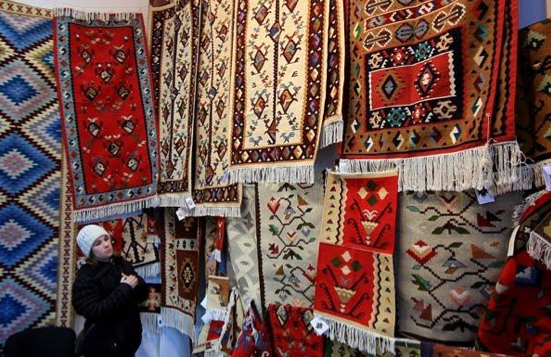
In the past years I worked on the renovation of our cottage in the Jablanica region of Serbia, and now what I'd like to hang on a wall of its living room is a traditional Kilim rug of Pirot (Пиротски Ћилим).


The Kilims of Pirot were usually used for covering floors, walls and for to be used as curtains, for bedspreds and for covering parts of furniture.
As part of the Serbian Heritage and Culture, those rugs are now often used for ethno style interiors and people who look at this picturesque folk art still gets inspired by its colors, ornaments, pattern and quality.


Kilim weawing was (and still is) a strenuous and laborious work, so it's often seen like a writing, a story and a diary of the person who made it. For centuries, women have been weaving their pain, joy, messages and symbols into the rugs.


Originally, these rugs were only an object of use, but slowly they became a symbol for heritage and were an inextricable part of the region in which they were created. Kilims were given as a gift only on special occasions – they decorated the salons of the Serbian dynasties of the Karadjordjevic and Obrenovic and rulers used to offer them to foreign diplomats, as a valuable gift and a unique souvenir from Serbia.

The most important ingredient for a good quality kilim is the wool (obtained from the sheep from the Stara Planina). Only a good quality wool is a guarantee for a long duration, a nice appearance and a high quality weaving.
The sheared wool gets classified by fiber length and then washed in boiling water, rinsed out, dried, bleached and dyed. By spinning the precious wool is transformed to yarn.


Pirot, situated on a caravan road between the Middle East (Among the most famous kilims are the ones from Persia, Afganistan, China and the Caucsus) and Europe, became a famous center for this ancient weawing technique.
In the 16th century, when rugs were made exclusively for domestic needs, the kilims were simple and mostly uncolored. However also multicolored rugs (called “ŝarenice”) were made.
In the 17th and 18th century the kilim making was improved and weaving was done on a vertical loom known under the name of “Pirot loom”. The Pirot vertical loom is a simple device leaned against a wall.


 In the 19th century, the Pirot kilim reached the highest technical and art values with its real wealth of ornaments, colors and motifs. The kilims were earlier dyed by natural plant dyes later artificial (industrial) ones were used allowing more nuances of one color.
From century to century the kilim is crafted less and less in private houses and more and more in manufactures like the ones in Pirot during the 18th and 19th century. At the end of the 19th century Pirot had 250 looms and between two world wars a half of the whole women inhabitants of Pirot were involved in kilim making.
In 1886 the Kilim society of Pirot was founded and in international exhibitions and fairs Pirot kilims started to win gold-medals.
In 2002 Pirot Kilim became a Serbian Brand with protected geographical indication with 122 ornaments and 96 types of rugs registered.


Patterns and Motifs
The ornaments are always geometrical and the the same pattern appears repeated in different colors. Across the time they have always been transformed and enriched continually.
The most common pattern are:
rhombs, stylized “mirab” (kind of pattern), little dining-tables, amulets, German boxes and bombs, French candies, chests (“kuveri”)
then there are figurines like lizards, flames, small birds, scorpions, branches, doves in several variants, roses in several forms, pomegranates, wreaths, cross section of flowers braided into a wreath, flowers (carnations, pansies, tulips, roses).

Colors
А bold red color in several nuances – from light red to the color of rotten sour cherries prevails on Pirot kilims. The blue color is often used (gained of natural indigo) with little of yellow and white color (since mid of the 19th century, before the color beige made of onion leaves was used as white).


More information abоut Kilims:
The website of the Guild of the Kilimmakers in Pirot : Damsko Srce (http://www.damskosrce.com/)

On Wikipedia the best Information about Pirot Kilims is in German (relying on the book about Kilims from Peter Bausback, 1983: Kelim. antike orientalische Flachgewebe. Klinkhardt & Biermann, München. ISBN. 3-7814-0206-1)

A good document about the sheeps of Stara Planina is a little information brochure from Sergej Ivanov (from which I used the pictures for this post)

A good website with lots of infromation about Pirot kilims:
http://www.kilimpirot.com/

Very beautiful picture of old Kilims on Tanjica's Flickr site:  http://www.flickr.com/photos/tanjica/2699490642/

And here my post about the Serbian Pavillon at the Shanghai-Expo with a facade inspired by Pirot Kilims http://sajkaca.blogspot.ch/2010/02/serbia-on-expo2010-in-shanghai.html

December 17, 2012

From Russia to Serbia


This weekend the Serbian Broadcast Company RTS aired a rerun of the great show "Sasvim Prirodno" (All about Nature)  and this time author John Memedović ended up in Russia from where he brought a very unusual story.

Together with 20 Russians and cinematographer Soni Darijević he sailed on three ancient Russian sea boats – the Vityaz, the Khrabr and the Slavyana all the (water)way from Russia’s Samara Region to Belgrade. 

The idea to travel 5'000 km like this came from Russian monk Father Feoktist and author John Memedović, for a good story, could not turn down this proposal…he accepted the anything but confortable way to travel, and even if he had really to struggle he jumped in and documented this trip.

"In today's time we live fast and constantly look for new things and values change all the time, so we are prone to forget the origins and we move away from the traditions ... " says Memedović.
 
Because of that, this intrepid crew did something completely opposite: they turned the clock 1'000 years back and slowed down the time. With great respect for history and heritage they went through this journey and made a very interesting doc.


I really enjoyed the beautiful landscapes….and listen to the beautiful song "Serbia" of Otac Feoktist (song in russian language, serbian translation underneath)

To see the documentary in Serbian her are the links: Part 1 unad Part 2


Од давнина гарде непријатеља су твоју душу тугом палиле.
Али разапети твој дух, да би угасили ватру, цео свет није могао.
Царство Христа не силази с крста, бићемо заједно са тобом!
Црни зли ветрови неће угасити ватру -- близак је наш последњи бој!
Сутра је наш последњи бој.

Рефрен:

Србијо, Србијо, ти си љубав моја, ти си сестра моја, Србијо, Србијо!

Лепотом чудесна, светла земља, острво православља.
Господу верна, Светог Духа пуна, Божја Југославија.
Мили Радивоје, златни витеже, стаћемо, брате, раме уз раме.
Богатир је с тобом, исукаће свој мач, упалићемо свећу пријатељства.

Долине и гребени, куполе, крстови, звоњава звона позива.
Дечицу да роде, у Христу да расту, ред је на српске мајке.
Много година, живела заувек, буди снажна сама у себи.
Од сестре рођене, од свете Русије, Србијо, поклон теби.


Od davnina garde neprijatelja su tvoju dušu tugom palile,
Ali razapeti tvoj duh da bi ugasili vatru, ceo svet nije mogao.
Carstvo Hrista ne silazi sa krsta, bićemo zajedno sa tobom!
Crni, zli vetrovi neće ugasiti vatru -- blizak je naš poslednji boj!
Sutra je naš poslednji boj.

Refren:

Srbijo, Srbijo, ti si ljubav moj, ti si sestra moja, Srbijo, Srbijo!

Lepotom čudesna, svetla zemlja, ostrvo pravoslavlja.
Gospodu verna, Svetog Duha puna, Božija Jugoslavija.
Mili Radivoje, zlatni viteže, staćemo, brate, rame uz rame.
Bogatir je s' tobom, isukaće svoj mač, upalićemo sveću prijateljstva.

Doline i grebeni, kupole, krstovi, zvonjava zvona poziva.
Dečicu da rode, u Hristu da rastu, red je na Srpske majke.
Mnogo godina, živela zauvek, budi snažna sama u sebi,
Od sestre rođene, od Svete Rusije, Srbijo poklon tebi!