Showing posts with label Central Serbia. Show all posts

May 24, 2013

Architecture of Bus Stations in Serbia

Central Bus Station in Niš (picture from wikimapia)

I got inspired for this post by Yomadic's blog entry: http://www.yomadic.com/bus-from-belgrade-to-nis-serbia/ and his beautiful picture of the Niš Bus station.

Since in the Balkans, particularly in Serbia, Railway travelling was never so popular like traveling by bus, some Bus Stations got a lot of architectural attention when they were built.

I found pictures from some interesting Bus Stations and hope to expand this collection soon!


Niš Bus Station

Entrance of the Bus Station (picture wikimapia)
One of them is the Bus Station in Nis (Ниш) built in 1977 and one of the most modern Bus Station of the Socialist Federal Republic of Yugoslavia with 18 platforms. Nis-Ekspress AD was the main investor.

Ćuprija Bus Station

Bus Station in Čuprija


A lot of inhabitants of Ćuprija work as "Gastarbeiter" in Western Europe, so really lots of Bus Lines serve this little town. That explains the big Bus Station at the entrance of the town.
A close up shows the lamellar structure of the roof supported by precast columns arranged in a semi-circle.


Novi Pazar
A postcard from the 70's of Novi Pazar's Bus Station
Another interesting Bus Station  is the one in Novi Pazar built in the 1970's. The first time I visted Novi Pazar I was fascinated by it's frivolous architecture (read it in my post about Novi Pazar).

A newer picture on autobusi.net
The Bus Station fits in that style, and though it shows signs of age and people complain about its flaws it still looks charming.

Loving this combination: the bus station and his "soliter" a stand alone highrise building (from autobusi.net)


Zrenjanin

Zrenjanin Bus Station (from autobusi.net)

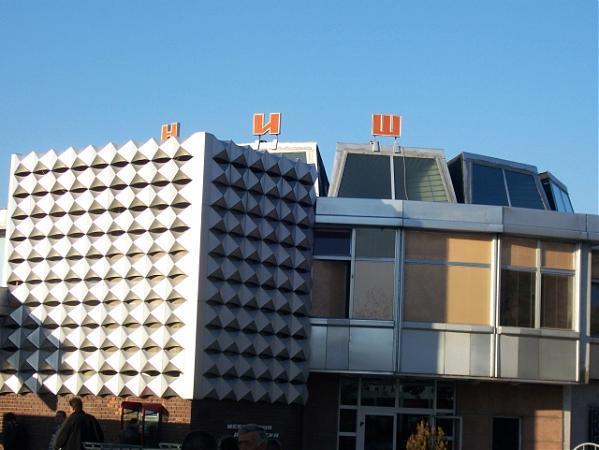
In Zrenjanin the Bus Station has a relief-like Fassade like in Niš. It/s not a big station, but with this detail it looks almost like an airport.

November 7, 2011

Crna Trava


 I had always heard about a place called Crna Trava in the South od Serbia and its famous construction workers which built the most significant buildings of the SFRJ. When last summer I visited Crna Trava I found a sleepy but interesting settlement in a beatuiful landscape worth sharing a couple of pictures!

The main square

Crna Trava (Црна Трава) a village in southeast of Serbia lays in a beautiful plateau of the Vlasina region (the mountainous region near the border to Bulgaria) . The beautiful setting along the Vlasina river (which starts 10km before at Vlasinsko Lake (Власинско језеро) and the surrounding mountains makes it a picturesque settlement.
  
Nonetheless in the statistics it’s one of the poorest municipality of Serbia.
From a population of 13,748 in 1953 the number of inhabitants dropped to just 2'563 in 2002 and goes along with the heavy depopulation (mainly for economic reasons) of the entire Vlasina region.


 the town house on the main sqare

the hotel

the school


Since back to roman times, people of Crna Trava were freedom lovers, and fighted against ocupation of Turks, Bulgarian and Fascism. Also a lot of fugitives from regions like Kosovo, Raška, Metohija, Kopaonik and Makedonia, who escaped from Turkish ocupation 400 years found in hidden mountainous places like Crna Trava a new home.
Life was hard in those places but at least people didn’t have to addapt to the Tursk.


People from Crna Trava were the most wellknown migrant workers (печалбари) of the former Yugolsavian territory. They were known as good construction workers. So the male population was always on the road to look for work and an big part of the great building projects of the communist time in Belgrade, Skopje and other cities of SFRY were made by those migrant workers.
  

The female population looked after the house, fields, animals and relatives alone waiting fort he husbands to return (in the good cases with the money they made on building sites).

Today in Crna Trava there are no migrant workers anymore, maybe still some older guys still singing migrantworkers-songs and remembering the old times.
 
There is still a big Construction-School (with campus)


Crnat Trava has evrything a little city needs: a health center, a town house, a police station, taverns, markets, a kindergarten, elementary and secondary schools, a students dorm, a library, a hotel, a square with a monument to the fallen soldiers ... but no people.

The Crna Trava area is in need of a longterm strategy to promote the region. The beautiful setting, an already existing infrastructure and a healthy environment should be a good potential to attract investors for construction related business or for health food development.

More about Crna Trava:
Tourist attractions in Crna Trava on National Tourism Organization of Serbia (eng) 
 Picutres on Panoramio of Crna Trava

June 26, 2011

Interesting buildings in Arandjelovac

After checking out interesting buildings in Kragujevac (here) I collected here a few interesting buildings in Arandjelovac (Аранђеловац) in Central Serbia which like Kragujevac also lies in the Sumadija region and has about 50'000 inhabitants.

Architecture is not the reason why this city is visited by tourists, however I found a couple of interesting buildings I'd like to share here.

Arandjelovac is mostly known for  the spring of the popular mineral water "Knjaz Milos" and the appertaining Spa "Bukovicka Banja". The Spa has a great park loaded with sculptures international artists (since 1966 the city invites  artist from all over the world and let them have one of their sculptures exposited in the Park.


Inside the Spa facilities there is an example of Serbian Romaticism it's the "Staro Zdanje" (the Old Building) and is the oldest preserved building in Bukovicka Banja Spa. It was initiated by Prince Mihailo Obrenovic (that's why the mineral water is called "Knjaz Milos") in 1865 and was intended as his summer residence and for Assembly meetings.

Here an old picture of the building.
Its architect, Kosta Sreplovic, the Munich school of architecture graduate, landscaped the park area in front of the edifice as well. When the edifice was completed in 1872, the purpose of its use was changed due to altered political situation so that it became a spa edifice, probably the largest of the kind in Serbia of the time.

Today it is a hotel and the symbol of Arandjelovac that appears in its coat of arms, prospectus leaflets and postcards. 


This highrise building is known as the "arandjelovac soliter" and is in the center of the city.I love the rounded details and the material combinations.(picture source)

 Blocks like this remind a lot the Style of Novi Beograd.


 A really cool building and and a sign of past socialist times is the shopingcenter "Kolektiv" (Робна кућа Колектив) with its sculptural facade.(picture source)

Here an old Postcard with the Kolektiv-Building and the Arandjelovac-Soliter in the background.


Another interesting building is the the one with the "Pekabeta" on the ground-floor. The peculiar blue attic adds a fun touch to the edifice and makes it unique.(picture source)


 The building of the Municipal Court has also a socialist time touch.


And now a really beautiful example of Brutalism: the Bukulja observatory tower on the Bukulja Mountain near Arandjelovac on 660 m. above sealevel and 19m high, made in nice face concrete. From the top there is a nice view to the surrounding mountains. Now it's planned to put a telescope up there to make it a even better tourist attraction.

 Anrandjelovac is worth a trip also for the cultural meaningful surrounding: The Bukovicka Spa, Topola with the Oplenac Royal Mausoleum and the Risovaca Caves.

June 16, 2011

Interesting Buildings in Kragujevac


Now that the traveling season starts and a few of my readers were asking for architectural tips outside from Belgrade, I decided to publish the most interesting buildings of smaller Serbian cities next to useful traveling information.

I started with Kragujevac and I choose the buildings that I like the most. Kragujevac is the center of the Sumadija region, the region that represent Serbia in all its stereotypes (for instance the Sumadija folk costume stands generally as illustration for Serbian national costume).


Blocks in Kragujevac (from flickr)


The architecture of Kragujevac is a mix of various styles: there are Oriental-Style buildings  (like the Amidža Konak from 1819-24) and Secession Style buildings  from 19th century. Then there are modern post-war concrete buildings (apartments to house those left homeless during World War II), high-rise commies (communist time blocks)  and some eye-catching buildings from the 70'ies (like the "Ipsilon" and the City Hall) that now characterize the city's panorama.


Kragujevac City Hall (Скупштина града)from Dinke at flickr


The Y - Building (Ипсилон) in Erdoglija District was built in the 70's and is Kragujevac's tallest building (60m, 17 floors)

Ipsilon Building from woodland at Skyscrapercity


The Golden Rose Shopping Center "Златна Ружа" is a cool building, however it needs some remodeling work. (from Johnny-kg at skyscrapercity)


Fire station in ulica Miloja Pavlovića (Ватрогасци дом) picture from skyscrapercity. Below an old picture of the building.

The fire station is a modernist building from 1932 (built in less than one year!)after the project of Đorđe Kovaljevski i Mihailo Radovanović, two Belgrade architects.

The "Zastava"-Building is a good example of soc-realism. (Picture from kawasaki KG at skyscrapercity)

The history behind the building and what happened to the Zastava Industry is a bit complexer. In a very simple and short form I see it like this: The biggest and flourishing Industry that produced some Yugoslavian legendary cars was wrecked by NATO bombings and later through Embargo  and Sanctions. Now Italy (who 11 years ago was bombing the buildings) is trying to produce FIAT cars in these buildings, to make cheaper production with cheap Serbian workers and taking away the works to many Torino based workers in Italy…..but that's business…
Main site of Zastava


An interesting building (I already wrote about this one here) is located a little outside Kragujevac in the Šumarice Memorial Park (Меморијални парк Шумарице), is the Museum of Genocide, on the site where  in WW II between 2'300 and 7'000 men and boys (the numbers differs a lot from source to source, but that's another issue…) were executed by the German occupation forces on October 20, 1941.
The project is made by Ivan Antic.
Antic designed the Museum of the Genocide in 1967. The grandness of the monumental building is emphasized by a series of tall pillar-like rectangular shapes, the tallest ones on the central part from which go the same ones of various height with massive parts of the walls built in brick.
The modern expression relates to medieval sacral architecture, and the symbol of the Museum of the Genocide is even stronger in the interior which lets natural light from roof lanterns, connecting the view to the skies with earthly life: the building and the crypt.

On May 14th 1999 due to the detonation of NATO attacks in the nearest vicinity the facades of the Museum were damaged and all glazed panels and roof lanterns destroyed. The nearby building of the Archives was badly damaged. (picture from skyscrapercity)

There is also a famous monument called "Broken Wings"-Monument created in 1963 by Serbian sculptor Miodrag Zivkovic.
 The monument is dedicated to the killed schoolchildren and their teachers.
"Broken wings" monument in Sumarice memorial park (picture from Balkanforum)


Here a few links with travel tips for Kragujevac:

http://www.kragujevac.rs
http://wikitravel.org/en/Kragujevac

And here a cool blog from JohnnyKG  that has pictures and further Kragujevac links.
http://johnny_kg.mojblog.rs/
Enhanced by Zemanta

October 26, 2009

Best travel tips for Serbia - ETHNO VILLAGES

Links for Tour 4: Enjoying rural tourism and Serbian traditions in ethno villages


After general travel tips for Serbia, tips for a citytrip in Belgrade, tips for a bike tour through West Serbia and tips for discovering spiritual and cultural heritage in Raska and Kosovo I'm now sharing tips for a nice way to discover the beautiful traditions of the Serbian culture in Serbian ethno villages (етно село).

Most of the Serbian villages looks so authentic that you can call almost every village an "ethno village". There are some that are a little bit more styled and preserved like Sirogonjo (I wrote about it here) and Trsic (I wrote about it here) for exemple.

a village in south of Serbia

But in any rural area of Serbia you find pictures places where you can spend a couple of days in a healthy area and make some day trips to interesting cultural sites!
How to find a rural house for the holidays:

The ladies at panacomp organize not only accomodations in ethno houses, but also workshops and activities by request (like folk dances etc.)
Here a link to a general owerview about rural tourism

And here the "panacomp" list of housholds that are renting for tourists

old buildings in the village

Another site to find a nice ethno house to rent is this site of Serbian villages "selo"
This site promotes alternative and responsible tourism: "Travelling Balkans"
I like also this link of "Odmor na selu" (Vacation in the village) it's about a village near Valjevo.

Salas in Vojvodina

the yard of a typical Salas

In Vojvodina the northern region of Serbia in the Pannonian plain has many farm estates called "salas" (салаш) a cluster of farmhouse, economic buildings and stables distanced from urban areas. Now you can't almost find quieter places to stay that a solitary salas!
Here a list on "Serbia tourist guide" with Vojvodian salas to rent


A village that I know and that I find very beautiful (and it's near Subotica and Sombor for excursions) is Stara Moravica, a village with Hungarian ethnic majority. Here a site with a salas in Stara Moravica to rent (some links of the site do not work properly at the moment)...

a typical village in Vojvodina


Free guides for Serbia:
You can read big parts of the Bradt Travel Guide for Serbia online here
A little printable guide of Serbia in three languages (serbian/english/german) You can order also your free copy...if you have the patience to wait....(it took many weeks for us)
Also good links for touristic informations about Serbia are the following sites:

The National tourist organization of Serbia has a very nice site, where you can explore culture, regions, food and traditions
Another good site full of information is "Visit Serbia"
In your pocket guide of Serbia (good online presentation)