As the patron saint of the former Yugoslavia, St. Sava, or Sveti Sava, is commemorated on the anniversary of his death with special church services, speeches, and choral singing. Schoolchildren sing, dance, and recite poems in his honor.
January 16, 2013
Serbian Orthodox Holidays
As the patron saint of the former Yugoslavia, St. Sava, or Sveti Sava, is commemorated on the anniversary of his death with special church services, speeches, and choral singing. Schoolchildren sing, dance, and recite poems in his honor.
December 29, 2012
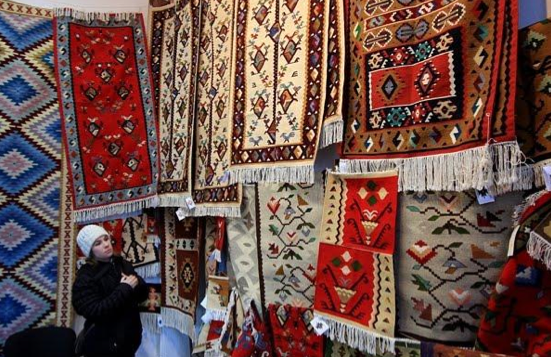
Kilim Rugs from Pirot
In the past years I worked on the renovation of our cottage in the Jablanica region of Serbia, and now what I'd like to hang on a wall of its living room is a traditional Kilim rug of Pirot (Пиротски Ћилим).
The Kilims of Pirot were usually used for covering floors, walls and for to be used as curtains, for bedspreds and for covering parts of furniture.
As part of the Serbian Heritage and Culture, those rugs are now often used for ethno style interiors and people who look at this picturesque folk art still gets inspired by its colors, ornaments, pattern and quality.
Kilim weawing was (and still is) a strenuous and laborious work, so it's often seen like a writing, a story and a diary of the person who made it. For centuries, women have been weaving their pain, joy, messages and symbols into the rugs.
Originally, these rugs were only an object of use, but slowly they became a symbol for heritage and were an inextricable part of the region in which they were created. Kilims were given as a gift only on special occasions – they decorated the salons of the Serbian dynasties of the Karadjordjevic and Obrenovic and rulers used to offer them to foreign diplomats, as a valuable gift and a unique souvenir from Serbia.
The most important ingredient for a good quality kilim is the wool (obtained from the sheep from the Stara Planina). Only a good quality wool is a guarantee for a long duration, a nice appearance and a high quality weaving.
The sheared wool gets classified by fiber length and then washed in boiling water, rinsed out, dried, bleached and dyed. By spinning the precious wool is transformed to yarn.
Pirot, situated on a caravan road between the Middle East (Among the most famous kilims are the ones from Persia, Afganistan, China and the Caucsus) and Europe, became a famous center for this ancient weawing technique.
In the 16th century, when rugs were made exclusively for domestic needs, the kilims were simple and mostly uncolored. However also multicolored rugs (called “ŝarenice”) were made.
In the 17th and 18th century the kilim making was improved and weaving was done on a vertical loom known under the name of “Pirot loom”. The Pirot vertical loom is a simple device leaned against a wall.
In the 19th century, the Pirot kilim reached the highest technical and art values with its real wealth of ornaments, colors and motifs. The kilims were earlier dyed by natural plant dyes later artificial (industrial) ones were used allowing more nuances of one color.
From century to century the kilim is crafted less and less in private houses and more and more in manufactures like the ones in Pirot during the 18th and 19th century. At the end of the 19th century Pirot had 250 looms and between two world wars a half of the whole women inhabitants of Pirot were involved in kilim making.
In 1886 the Kilim society of Pirot was founded and in international exhibitions and fairs Pirot kilims started to win gold-medals.
In 2002 Pirot Kilim became a Serbian Brand with protected geographical indication with 122 ornaments and 96 types of rugs registered.
Patterns and Motifs
The ornaments are always geometrical and the the same pattern appears repeated in different colors. Across the time they have always been transformed and enriched continually.
The most common pattern are:
rhombs, stylized “mirab” (kind of pattern), little dining-tables, amulets, German boxes and bombs, French candies, chests (“kuveri”)
then there are figurines like lizards, flames, small birds, scorpions, branches, doves in several variants, roses in several forms, pomegranates, wreaths, cross section of flowers braided into a wreath, flowers (carnations, pansies, tulips, roses).
Colors
А bold red color in several nuances – from light red to the color of rotten sour cherries prevails on Pirot kilims. The blue color is often used (gained of natural indigo) with little of yellow and white color (since mid of the 19th century, before the color beige made of onion leaves was used as white).
More information abоut Kilims:
The website of the Guild of the Kilimmakers in Pirot : Damsko Srce (http://www.damskosrce.com/)
On Wikipedia the best Information about Pirot Kilims is in German (relying on the book about Kilims from Peter Bausback, 1983: Kelim. antike orientalische Flachgewebe. Klinkhardt & Biermann, München. ISBN. 3-7814-0206-1)
A good document about the sheeps of Stara Planina is a little information brochure from Sergej Ivanov (from which I used the pictures for this post)
A good website with lots of infromation about Pirot kilims:
http://www.kilimpirot.com/
Very beautiful picture of old Kilims on Tanjica's Flickr site: http://www.flickr.com/photos/tanjica/2699490642/
And here my post about the Serbian Pavillon at the Shanghai-Expo with a facade inspired by Pirot Kilims http://sajkaca.blogspot.ch/2010/02/serbia-on-expo2010-in-shanghai.html
December 17, 2012
From Russia to Serbia
Together with 20 Russians and cinematographer Soni Darijević he sailed on three ancient Russian sea boats – the Vityaz, the Khrabr and the Slavyana all the (water)way from Russia’s Samara Region to Belgrade.
"In today's time we live fast and constantly look for new things and values change all the time, so we are prone to forget the origins and we move away from the traditions ... " says Memedović.
I really enjoyed the beautiful landscapes….and listen to the beautiful song "Serbia" of Otac Feoktist (song in russian language, serbian translation underneath)
Од давнина гарде непријатеља су твоју душу тугом палиле.
Али разапети твој дух, да би угасили ватру, цео свет није могао.
Царство Христа не силази с крста, бићемо заједно са тобом!
Црни зли ветрови неће угасити ватру -- близак је наш последњи бој!
Сутра је наш последњи бој.
Рефрен:
Србијо, Србијо, ти си љубав моја, ти си сестра моја, Србијо, Србијо!
Лепотом чудесна, светла земља, острво православља.
Господу верна, Светог Духа пуна, Божја Југославија.
Мили Радивоје, златни витеже, стаћемо, брате, раме уз раме.
Богатир је с тобом, исукаће свој мач, упалићемо свећу пријатељства.
Долине и гребени, куполе, крстови, звоњава звона позива.
Дечицу да роде, у Христу да расту, ред је на српске мајке.
Много година, живела заувек, буди снажна сама у себи.
Од сестре рођене, од свете Русије, Србијо, поклон теби.
Od davnina garde neprijatelja su tvoju dušu tugom palile,
Ali razapeti tvoj duh da bi ugasili vatru, ceo svet nije mogao.
Carstvo Hrista ne silazi sa krsta, bićemo zajedno sa tobom!
Crni, zli vetrovi neće ugasiti vatru -- blizak je naš poslednji boj!
Sutra je naš poslednji boj.
Refren:
Srbijo, Srbijo, ti si ljubav moj, ti si sestra moja, Srbijo, Srbijo!
Lepotom čudesna, svetla zemlja, ostrvo pravoslavlja.
Gospodu verna, Svetog Duha puna, Božija Jugoslavija.
Mili Radivoje, zlatni viteže, staćemo, brate, rame uz rame.
Bogatir je s' tobom, isukaće svoj mač, upalićemo sveću prijateljstva.
Doline i grebeni, kupole, krstovi, zvonjava zvona poziva.
Dečicu da rode, u Hristu da rastu, red je na Srpske majke.
Mnogo godina, živela zauvek, budi snažna sama u sebi,
Od sestre rođene, od Svete Rusije, Srbijo poklon tebi!
March 18, 2012
Vranje
Since I saw movies like Zona Zamfirova and Ivkova Slava I always had the wish to visit Vranje, a lively city of South Serbia. From our family home in Kovaceva Bara it's just about an hour of traveling, but somehow I never made it to Vranje until last summer, when we wanted to show the area to my relatives from Italy! My husband made us a tour of the region and so I had finally the oppurtunity to visit Vranje!
In ancient times, various tribes inhabited present-day Vranje, until the Romans conquered the region in the 2nd and 1st centuries BC. The Roman fortresses in the Vranje region were abandoned during the Hun attacks in 539-544 AD. The name Vranje stems from the old word for "black" ("vran") in Serbian. Vranje was an important Ottoman trading site.
Around Vranje’s busy pedestrian zone is the Pasha’s residence on Pionirska Street. The complex comprises two buildings erected by Raif beg Džinić in 1765 as his residence. Its architecture is a typical example of South Serbian architecture.
The daughter of the last pasha sold it to the local metropolitan bishop who converted the building into Vranje’s first high school in 1881.
The building’s front residence, the selamluk was reserved exclusively for men. It faces the street was used by Pasha and his male entourage. The sheltered rear residence, theharemluk, was reserved for women.
King Milutin annexed Vranje to the Serbian medieval state in 1282, the same year he acceded to the throne. Vranje consequently became the center of the župa (a small administrative division).
The school is a an exemple of modern socialist style mixed up with oriental details. Vranje is one of the Serbian cities where the Tursk stayed the longest and it shows in many details of architecture.
The White bridge is a symbol of the city and is called "most ljubavi" (Lovers bridge) after the tale about the forbidden love between the Muslim girl Ajša and Serbian-orthodox Stojan that resulted in the father killing the couple. After that, he built the bridge where he had killed her and had the story in-scripted in Ottoman Arabic.
The Burberry signature on a building in the center of Vranje :-)
Colorful buildings at the entrance of Vranje
November 27, 2009
Ethnographic Museum in Belgrade

This building was originally designed as the Stock Exchange by Milutin Borisavljevic (1889-1970) and it was built in 1934.
Since 1951 the Ethnographic Museum has been located here. The mueseum contains a wealth of objects and docments on the culture of Serbia and Yugoslavia.
The permanent collection – “Folk art in Serbia” – comprises of folk costumes,fabrics, rugs, and handicraft tools. The museum also has a library and a hall for lectures and cultural events.
At the beginning of the 20th century, the Ethnographic Museum exhibited at shows in St. Petersburg, Paris, London and Prague presenting Serbian culture. (two pictures from rascian at skyscrapercity)
Milutin Borisavljevic was an architect and also an esthetic expert. He studied in Paris at the Sorbonne. The ethnographic museum was one of his main works. In the nearby Studentski Park (former Pancic Park) he designed the fences. (They are made like the cirillic letter „R“ with two cast-iron gates)
Also a major work of him was the Flasar House (Kornelijs Stankovica 16) here in a picture of Goldstajn at skyscrapercity.
October 26, 2009
Best travel tips for Serbia - ETHNO VILLAGES
After general travel tips for Serbia, tips for a citytrip in Belgrade, tips for a bike tour through West Serbia and tips for discovering spiritual and cultural heritage in Raska and Kosovo I'm now sharing tips for a nice way to discover the beautiful traditions of the Serbian culture in Serbian ethno villages (етно село).
Most of the Serbian villages looks so authentic that you can call almost every village an "ethno village". There are some that are a little bit more styled and preserved like Sirogonjo (I wrote about it here) and Trsic (I wrote about it here) for exemple.
But in any rural area of Serbia you find pictures places where you can spend a couple of days in a healthy area and make some day trips to interesting cultural sites!
How to find a rural house for the holidays:
The ladies at panacomp organize not only accomodations in ethno houses, but also workshops and activities by request (like folk dances etc.)
Here a link to a general owerview about rural tourism
And here the "panacomp" list of housholds that are renting for tourists
old buildings in the village
Another site to find a nice ethno house to rent is this site of Serbian villages "selo" This site promotes alternative and responsible tourism: "Travelling Balkans"
I like also this link of "Odmor na selu" (Vacation in the village) it's about a village near Valjevo.
Salas in Vojvodina
In Vojvodina the northern region of Serbia in the Pannonian plain has many farm estates called "salas" (салаш) a cluster of farmhouse, economic buildings and stables distanced from urban areas. Now you can't almost find quieter places to stay that a solitary salas!
Here a list on "Serbia tourist guide" with Vojvodian salas to rent
A village that I know and that I find very beautiful (and it's near Subotica and Sombor for excursions) is Stara Moravica, a village with Hungarian ethnic majority. Here a site with a salas in Stara Moravica to rent (some links of the site do not work properly at the moment)...
Free guides for Serbia:
You can read big parts of the Bradt Travel Guide for Serbia online here
A little printable guide of Serbia in three languages (serbian/english/german) You can order also your free copy...if you have the patience to wait....(it took many weeks for us)
Also good links for touristic informations about Serbia are the following sites:
The National tourist organization of Serbia has a very nice site, where you can explore culture, regions, food and traditions
Another good site full of information is "Visit Serbia"
In your pocket guide of Serbia (good online presentation)
July 12, 2009
Vidovdan 2009 in Gracanica Monastery
Every year on Vidovdan (St. Vitus day, June 28th) in the beautiful and spiritual surroundings of the monastery the celebration for this serbian religious and national holiday takes place. Here the pictures that my friend Johanna sent me from this year's celebration. The text is from [ B92, Beta, Tanjug ]
GRAČANICA - The celebration of Vidovdan started in Kosovo this morning with the Holy Liturgy served in the Serbian Orthodox monastery of Gračanica.
Serbs mark Vidovdan (St. Vitus Day) as a religious and national holiday.
The province is calm and there are no incidents reported this Sunday, as Kosovo police, KPS, and KFOR members have visibly increased their presence near the Serb enclave of Gračanica, and also near Kosovska Mitrovica and Gazimestan.
This year's Vidovdan celebrations have gathered the largest crowd seen since 1999, with several thousand people in Gazimestan, near Priština, attending a commemoration of the anniversary of the Battle of Kosovo.
On this day 620 years ago, the Serb army, led by Lazar Hrebeljanović, confronted the invading Ottoman Turks.
Serbian Orthodox Church (SPC) Patriarch Pavle's emissary Metropolitan Amfilohije and bishops Artemije, Filaret and Teodosije served a religious ceremony dedicated to the souls of the fallen soldiers of the medieval Serbian empire - commonly referred to as the Kosovo heroes.
After the ceremony, Bishop Artemije told the crowd that "the Kosovo heroes have given their lives so that we can live in Kosovo and Metohija today."
The Serbs have gathered in Gazimestan, the bishop continued, to pray to the Lord and tell themselves and others that this is the holy Serb land, soaked with blood and tears of our ancestors.
"Kosovo was and will be the heart of Serbia, just as it was 620 years ago," he said.
The participants in the ceremonies today arrived in some 60 buses and several hundred private vehicles from all over Serbia, but also from Montenegro and the Republic of Srpska. KPS members and Czech KFOR soldiers secured the area close to the Gazimestan monument.
Unlike in previous years, this time a stage was set up, while the monument was draped with a huge Serbian national flag and a canvass with the fresco image of Holy Tsar Lazar.
Both the Gazimestan commemoration, and the one earlier in the day in the monastery of Gračanica were attended by government ministers Bogoljub Šijaković, Goran Bogdanović and Nebojša Bradić, and Crown Prince Aleksandar Karađorđević and his wife Katarina.
Some even better information about Vidovdan 2009 here at de[construct].net
March 14, 2009
Ljubostinja Monastery and the first Serbian poetess Jefimija

Todays post is dedicated to Biljana in Skopje, thanks to her I discovered the story of this great Serbian Poetess, a diplomatic and creative woman that despite the tragedies in her life believed in God's goodness and cared for her country.
Jefimija
Jefimija was born 1349 as Jelena and was a Serbian nun and known as the first Serbian poetess. She was the daughter of kesar Voichna in the time of Car Dusan. She married Jovan Ugljiesa the ruler of Serres that died on 26 September 1371 in the Battle of Maritsa. After she lived in Serres and later in Krusevac at the court of Car Lazar.
After the defeat of the Serbs against the Ottomans in the battle of Kosovo, Jefimija joined the Zupanja Monastery with Carica Milica and later they joined monastery Ljubostina. There she spent her last days as abbess with the name Jevpraksija.
Her early life was a tragedy: she lost her family, her house, all her possession, income, land. Later as abbess she was involved in diplomatic affairs, like helping Princess Milica to get intercession for Stefan Lazarevic who refused to participate in the campagne in Bosnia of 1398. She also helped to get the body of Holy Petka Paraskeva back to Serbia, so her mortal remains were hold in the Sveta Petka Church in Belgrade until 1521 (now they're in Romania).
Ljubostina Monastery
The church was painted just before the Kosovo battle. The original frescoes have survived only on pendetives, in the lower register of the drum and partially elsewhere. Especially interesting are the representations of the Old Testament prophets who vouch for the emergence of Christ.
Invited by princess Milica, painter Makarije of Zrze came to Ljubostinja in 1403, and carried out all the frescoes in the church.
He repainted the frescoes in the dome, only ten years old, and wrote out his name on the arch above the door between the narthex and the nave.
The family of Prince Lazar is portrayed on the west wall of the narthex: Lazar and Milica are on one side, and Despot Stefan and his brother Lord Vuk on the other. They are all depicted in their full arrays, with all the insignia of power and dignity.

Unfortunately, little has remained of once vast painted area of Ljubostinja. In the nave, only the Annunciation unit of the whole Festival Cycle has survived. The four best-preserved compositions represent Christ's miracles and sermons: the Healing of the weakened man and the Anointment in Bethlehem above the south-choir door. The three major features of the Ljubostinja frescoes are expressive figures, strong contrast of light and dark, and architectural motifs in the background.
Architecturally, the church, dedicated to the Dormition of the Holy Virgin, belongs to the Morava School. Its ground plan has the form of a trefoil with a dome resting of four free-standing pillars. It is extended westward into a rectangular narthex with a blind calotte.The facade is embellished with rich muling that edge the doors and windows. A horizontal cordon cornice divides the walls into two zones: in the lower one, there are lancet and two-light windows, and the upper zone is ornamented with rose and wheel windows of unequal size with floral and geometrical patterns.
In the threshold stone of the doorway between the narthex and the nave, the name of the "Protomaster Borovic Rade", the famous master-builder, is chiseled.
The legends says that the monastery was built on a site where Princess Milica met Prince Lazar for the first time; and that had happened on the day of St Archdeacon Stefan to whom the earlier chapel on the same place had been dedicated. The construction of this foundation of Princess Milica and Prince Lazar started in 1388-89. After the battle of Kosovo, when Lazar was killed, Milica became a nun, as many widows of the Serbian soldiers did the same.
Eulogy for Knez Lazar
Her most meaningful work (and her first) is the eulogy for Knez Lazar (Похвала кнезу Лазару), a prayer in the shape of a poem. The text is preserved as a embroided blanked (the shroud for Lazar Herbeljanovic) that was made in the Ljubostina Monastery around 1402.
The text is embroided in gold on the shroud of Knez Lazarand now in the Museum of the Orthodox Church in Belgrade.
Here a Serbian transcription with English translation (from wikipedia):
У красотама овога света васпитао си се од младости своје
о нови мучениче кнеже Лазаре,
и крепка рука Господња међу свом земаљском господом
крепког и славног показа те.
Господствовао си земљом отачаства ти
и у свим добротама узвеселио си уручене ти хришћане
и мужаственим срцем и жељом побожности
изашао си на змију
и непријатеља божанствених цркава,
расудивши да је неистрпљиво за срце твоје
да гледа хришћане отачаства ти
овладане Измаилћанима,
не би ли како ово постигао:
да оставиш пропадљиву висоту земаљског господства
и да се обагриш крвљу својом
и сјединиш са војницима небескога цара.
И тако две жеље постигао јеси:
и ЗМИЈУ убио јеси
и мучења венац примио јеси од Бога.
Сада не предај забораву вољена ти чеда
која си сирота оставио преласком ТВОЈИМ,
јер откако си ти у небеском весељу вечном,
многе скрби и болезни обузеше вољена ти чеда
и у многим скрбима живот проводе,
пошто су овладани Измаилћанима.
И свима нам је потребна помоћ твоја,
те се молимо моли се заједничком Владики
за вољена ти чеда
и за све који им с љубављу и вером служе.
Тугом су многом здружена вољена ти чеда,
јер они што једоше хлеб њихов подигоше на њих буну велику
и твоја добра у заборав ставише,
о мучениче.
Но ако сиНо ако си и прешао из живота овога,
скрби и болезни чеда својих знаш
и као мученик слободу имаш пред Господом,
преклони колена пред Владиком који те венчао,
моли да многолетни у добру живот
вољена ти чеда проводе богоугодно,
моли да православна вера хришћанска
неоскудно стоји у отачаству ти,
моли победитеља Бога
да победу подари вољеним ти чедима,
кнезу Стефану и Вуку,
за невидљиве и видљиве непријатеље,
јер ако помоћ примимо с Богом,
теби ћемо похвалу и благодарење дати.
Сабери збор својих сабеседника, светих мученика,
и са свима се помоли прославитељу ти Богу,
извести Георгија,
покрени Димитрија,
убеди Теодоре,
узми Меркурија и Прокопија
и четрдесет севастијских мученика не остави,
у чијем мучеништву војују чеда твоја вољена,
кнез Стефан и Вук,
моли да им се пода од Бога помоћ,
дођи, дакле, У помоћ нашу, ма где да си.
На моја мала приношења погледај
и у многа их урачунај,
јер теби не принесох похвалу како приличи,
већ колико је могуће маломе ми разуму,
па зато и мале награде чекам.
Но ниси тако ти, о мили мој господине и свети мучениче,
био малодаран у пропадљивом и маловечном,
колико више у непролазном и великом,
што примио јеси од Бога,
јер телесно страну мене у туђини
исхрањивао јеси изобилно,
те сада те молим обоје:
да ме исхраниш
и да утишаш буру љуту душе и тела мојега.
Јефимија усрдно приноси ово теби свети.
In the beautiful of this world you raised yourself from your youth
O, New Martyr, Knez Lazar,
And God's strong and glorious hand
Pointed at you, among all the lords of the earth.
You lorded over your fatherland
And with your goodness delighted
The Christians under your wing.
And with a martyr's heart and a wish for blessing
You went against the dragon
And against the enemies of the holy churches.
Having deemed it unbearable for your heart
To see the Christians of your fatherland
Be conquered by the turks
In order to achieve these
To leave the unstable height of earthly lordship
And to spill your blood
And to join the soldiers of the heavenly emperor.
And so you achieved two wishes:
You killed the dragon
And received a martyr's wreath from God.
And now do not forget your beloved children
Whom you left orphaned by your transition.
For since you achieved the bliss in the eternal celestial joy
Many hardship and suffering fell upon your children
And in many misfortunes they spend their lives,
Because they are conquered by the Turks
And they need your help.
For this I beg you,
Pray to the universal ruler for your children,
And for all those who serve them with love and faith,
for they are fettered with worries,your beloved children
Those who ate their bread raised a conspiracy against them
And forgot your goodness,
o Martyr.
But since you passed from this life,
You know the worries and sufferings of your children
And as a martyr you are free before God.
Kneel before the Lord who wreathed you,
Pray that your children live long lives
In happiness pleasing to God.
Pray thar Orhodox Christian faith amply endures in your fatherland
Ask the victorious God to grant victory
to your beloved children, Knez Stephan and Vuk,
Against visible and invisible enemies.
For if we receive God's help
We will give you praise and gratitude
Call for a meeting of your fellow martyrs
And pray with them to the glorifying God,
Warn George
Move Demetrios
Persuade both Theodores
Take Merkourios and Prokopios
And do not leave out the forty martyrs of Sebaseia
In whose suffering now fight your children,
Knez Stephan and Vuk.
Pray that the help from God be given them.
Come then to our aid, wherever you are.
Consider my small contribution
and count it among many,
For I did not grant you the praise you deserve,
But only as far as my small mind allowed,
And so I expect but small rewards
For you were not selfish, My Lord and Martyr,
In this decaying and short lasting world,
But you are more generous in the everlasting and magnificent
That you received from God.
For you fed me profusely
When I was foreign in a foreign land
And now I beg you both:
To feed me
and to assuage the fierce storm in my soul and body
Jefimija humbly offers you this, O Holy One