April 6, 2013

Stara Planina Mountains

Stara Planina

The Stara Planina (that means old mountains) is a part of the Balkan mountain range and lays in Eastern Serbia on the border with Bulgaria. The Balkan range runs 560 km from Vrška Čuka Peak on the border between Bulgaria and eastern Serbia eastward through central Bulgaria to Cape Emine on the Black Sea.

The Stara Planina is remarkable for its flora and fauna, and also with steep cliffs, the highest waterfalls in the Balkan peninsula and lush vegetation. 

Geologically, the Balkan Mountains is a 'young' part of the Alp-Himalayan chain which stretches across most of Europe and Asia. 


It can be divided into two parts: the main Balkan Chain and the Pre-Balkans to the north, which intrude slightly into the Danubian Plain. 


On top of the Serbian part is this rock called "Babin Zub" (Grandmother's Teeth).


The surrounding are part of a ski recreational area in winter and full of nice hiking trails in summer.


I just took a few pictures while cruising around. I arrived by night at Babin Zub's Hotel after a drive through dark roads and the navigation telling that theres nothing further along. I really had no idea were I landed. 


The next day I was surprised with a nice scenery while driving to see the newly errected just opened Hotel Stara Planina.


Also the new Hotel was a pleasant surprise, instead of an overstated giant facility with no relation to the surrounding, the building looks solidly adapted to the rough mountain setting from the outside and the interior is appropriately stylish.


After visiting the area in summer, I now would like to visit the area in winter. 

Eastern Serbian mountains are as beautiful as the Western Serbian mountain (I wrote about those mountains here in my posts about the unique National Park Tara "Best travel tips for Serbia - TARA/KOPAONIK" and "Tara National Park in Western Serbia", the Ethno Village Sirogonjo "Etno Selo - Sirogonjo", the posts about the Zlatibor region: "More Ethno in Zlatibor", "Mokra Gora" and Ethno Village Mecavnik "Kusturica made it!".


March 28, 2013

Temska a beautiful village of eastern Serbia

Temska

While traveling through Eastern Serbia I particularly loved some of the characteristic and soulful villages driving along smaller roads. Those villages are far enough from urban centers so they're totally quiet, but still near enough to benefit from trade oportunities and public infrastructure the cities can offer. Temska is one of those really picturesque villages without being too glamed up.  


Typical example of moravian style rural houses in Temska

 beautiful barns, traditional wood construction

Temstica river
 With around 900 inhabitants, a ground school, postal office, a few stores and a coffee shop it looks like a lively neat place along the Temstica River (a affluent of the Nisava River). 

Beautiful wood constructed barns with tile roof (and a couple of goats on Temska's streets)


Near the settlement there is a small hydroelectric plant and the small Monastery dedicated to the Holy Martyr Saint George called Temska Monastery.


Erected on ruins of a fortification of the 11th century, the monastery was built in the second half of the 16th century by the Dejanovic Family (nephews of Tsar Dusan).
 The Konak (Guesthouse) is beautifully restored

 The monasterie's dormitory and living quarters built in the 18th century represent an excellent example of the local folk architecture 

On the porch of the building various natural balm and balsams with curative effects and produced in traditional way from medicinal herbs of the Stara Planina are sold. People stop by to buy such balms for curing eczema, psoriasis, dermatitis, neurodermatitis, atopic dermatitis, skin allergies, acne, burnt skin, insect bits, hemorrhoids, varicose veins, alopecia, sinusitis, inflammation of the ears and open wounds. 


The Temska Monastery church has a three-nave basis with a semicircular altar apsis and a low eight-sided dome. The monastery church itself was constructed of white stone and covered by stone layers. In 1654 a vault was added above the narthex instead of the old wooden construction and the porch was painted with beautiful frescoes.

Iconostasis of Temska Monastery Church

 Temska Monastery cimetery


To give you some more information on village architecture in Serbia I post the links of my 6 Lessons on Serbian Rural Architecture

Lesson 1 in Traditional Serbian Rural Architecture
Lesson 2 in Traditional Serbian Rural Architecture:Style by Regions
Lesson 3 in Traditional Serbian Rural Architecture: The South Serbian Village
Lesson 4 in Traditional Serbian Rural Architecture:The Family Homestead
Lesson 5 in Traditional Serbian Rural Architecture: The Moravian House and its Interior
Lesson 6 in Traditional Serbian Rural Architecture: How does "new" rural architecture looks like?

March 16, 2013

Donkey Cheese from the Zasavica Nature Park in Serbia

From this donkey comes the most expensive cheese in the world

When I visited the famous Serbian wildlife and nature reserves Zasavica one year ago while visiting Sremska Mitrovica (my post about it here) I didn't know that the world's most expensive cheese, made of donkey milk, is produced there!

I read here that the Nr.1 tennis player Novak Djokovic is buying an entire year production of this cheese to make it one of the key attractions at a chain of restaurants the Wimbledon champion and world number one is opening in his Serbian homeland.

Beside this interesting cheese story, Zasavica Park is indeed worth a visit. For all traveller who enter Serbia by the Zagreb-Beograd speedway Zasavica is on the road and makes a nice stop. 


Mangulica Pig

Mangulica is the only surviving autochthonous Serbian breed of domesticated pig. Other two, Šiška and Šumadinka died out. A breed, also known as "woolen pig", due to its good qualities, is considered a "noble", but it almost died out in the 1980s. 
Its fat has up to 80% less cholesterol and triglycerides than a common, white pig. In 1998 Mangulica was introduced in Zasavica, and are left to roam free in the reservation.

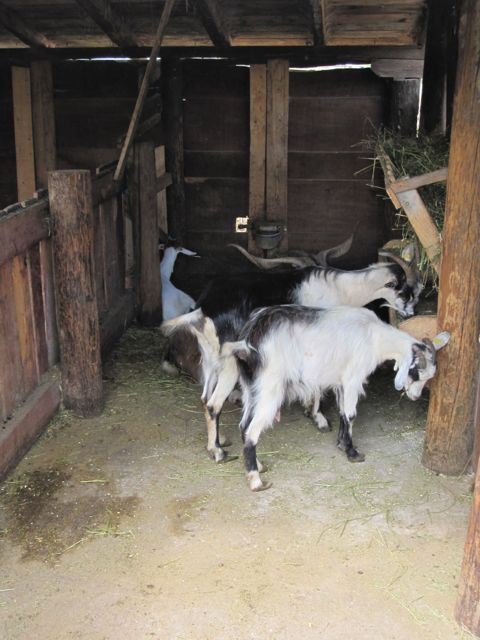
Goats


Sheeps

 
Agriculture:  
The concept for Zasavica Nature Park ist that Agriculture helps local farmers to gain income from the reserve and at the same time it is an essential tool for the management of specific habitats and species. Agriculture is restricted to grazing and hay making and famers are not allowed to use of pesticides, herbicides and chemical fertilizers. Preferably farmers use domestic cattle typical for the region like the Manguliza pig and Podolian cattle for grazing. 


Cattles

Podolian-Cattle 

In 1998 the cattle of the Podolian breed was introduced in Zasavica. First animals arrived in the spring of 1998 from Mionica, in western Serbia. Pasture "Valjevac", near the small Goransko-ribolovačko lake was chosen as their home. The pasture has an area of 3 square kilometers and today numbers 50 cattle. Breeding of Podolian cattle is being part of the program for the preservation of the animal species, developed by the Serbian Ministry of agriculture.


 Ethno architecture from Srem Region and Vojvodina


Biodiversity
In this habitat types and species (including meadows and pastures, open water, marshes, wet forest patches and upwelling water springs) of European and Serbian importance are settle here and live in a favorable conservation status. 

 
Educational program for schoolchildren, educational work camps and research camps are being organized with the purpose of increasing the awareness and knowledge on value and importance of protecting the wetland in general and Zasavica wetland in particular.


Here the official Website of the Zasavica Nature Park


March 5, 2013

Bukovo Monastery


A couple of kilometers from Negotin, on a forested hill lays the beautiful Bukovo Monastery overlooking villages toward the Dunav River and behind pieces of Romania and Bulgaria. 


The layout of the monastery (source)
 The monastery was founded by Serbian King Stefan Milutin (1282-1321) of the Nemanjic dynasty in the late 13th- or early 14th century.

The church is dedicated to St. Father Nikolaj the Wonderworker and by style is a special variant of the "Moravian School". The church has an elongated shape of a trefoil and was built as a single nave with arched barrel vault and without dome. The narthex was build later in the 19th century.

The wall around the monastery, the belltower and the colonnade were added in the 1930s.


In 2006 two new buildings were erected on the place of the old dorms, which were in ruinous state.

The church interior is richly decorated and in the narthex some frescoes in romantic style made in 1902 by Steva Todorovic shows some members of the Nemanjic Dynasty.


Fresco of Stephen Uroš II Milutin of Serbia (Стефан Урош II Милутин) and founder of the Bukovo monastery


Fresco of Stefan Nemanja (Стефан Немања) 1113 – 1199, Grand Prince of Raska from 1166 to 1196 and founder of the Nemanjić dynasty.


Fresco of Tsar Uros


In this fresco:
Sveti Sava (Rastko Nemanjic) came back from Hilandar Monastery (Mount Atos) to try to make peace between his two older brothers Stefan and Vukan (Stefan as second born was put on the thron instead of the oldest brother Vukan).


Fresco of  Stephen Uroš III (Стефан Урош III) , 1285 – 1331

The monastery has a good website with lots of pictures and information:
http://manastirbukovo.org

February 20, 2013

The Smederevo Fortress


40km south-east from Belgrade lays Smederevo a town of about 100'000 inhabitants and its Byzantine Monumental Complex: the Smederevo Fortress.
I like the setting of this fortress on the banks of the Danube.


Smederevo was the residence of Serbian prince Đurađ Branković and the capital of Serbia from 1430 until 1439, when it was conquered by the Ottoman Empire after a siege lasting two months.

The Smederevo Fortress was modeled after the Constantinople fortress. It's classed as a water fortress and after the fortress' completion, there was a decline in its military importance and few structural changes were made. As a result, the original architectural style has been preserved to this day.


Strategically the fortress is located on the right bank of the Danube river on the triangular plain formed by the confluence of the Danube and Jezava rivers, only 72 meters above sea level. This location allowed the Serbian capital to remain near the Christian Kingdom of Hungary, while also satisfying Sultan Murad II of the Ottoman Empire by eliminating the uncontrolled passage of the Hungarians into the Morava valley.

 The fortress' position connecting the Balkans and Central Europe has made it an important religious and commercial center for centuries.

During NATO agression against Serbia the "Jugopetrol" oil storage depot near Smederevo was bombed several times. Even though the facility is not located in the protected town zone, the force of the detonations and the burning of highly inflammable substances not only endangered the body of monuments in the town center but the strong detonations induced by the bombing caused shaking of the walls of the old town and the Fortress.


The fortress is currently used as a city park, and occasionally hosts cultural events. To the southeast, the previously open space along the Jezava now boasts a harbor. Unrestricted visits by tourists, inadequate protection, no maintenance and lack of strategy and financial resources contribute to the deterioration of the fortress.

The fortress is encircled by 1.5 kilometers of crenelated walls over 2 meters thick, and 25 towers which are each approximately 25 meters tall. 


The throne hall, where Branković received his visitors, was built with four double-arched windows, fashioned in a mixed Gothic/Romanesque style. 
The Donžon kula was intended to be the final line of defense. It was constructed with walls over 4 meters thick, and housed the nobility during Turkish attacks. Hidden doors were built into the Jezava wall, allowing for passage towards Hungary.
In the suburb, a sacral complex was built in phases from the 15th century onwards, and a Turkish bath was added by the Ottomans in the 17th century.
Between 1460–1480, while held by the Ottoman Empire, a larger defensive system was built, including escarpments, low walls, and more towers. During the first half of the 18th century, fortified trenches were added.


1. Main entry gate, 2. City gate II, 3. City gate I, 4. Ship gate, 5. Jezava gate, 6. Flag tower, 7. Turkish inscription tower, 8. Water tower, 9. Outer water trench, 10. Inner water trench, 11. Bridge, 12. Inner city gate, 13. Rectangular tower, 14. Keep (Donžon kula, Donjon tower), 15. Jerina's tower , 16. Despot's inscription tower (krstata kula), 17. Audience/Throne hall, 18. Palace, 19. Bath remains, 20. Church remains